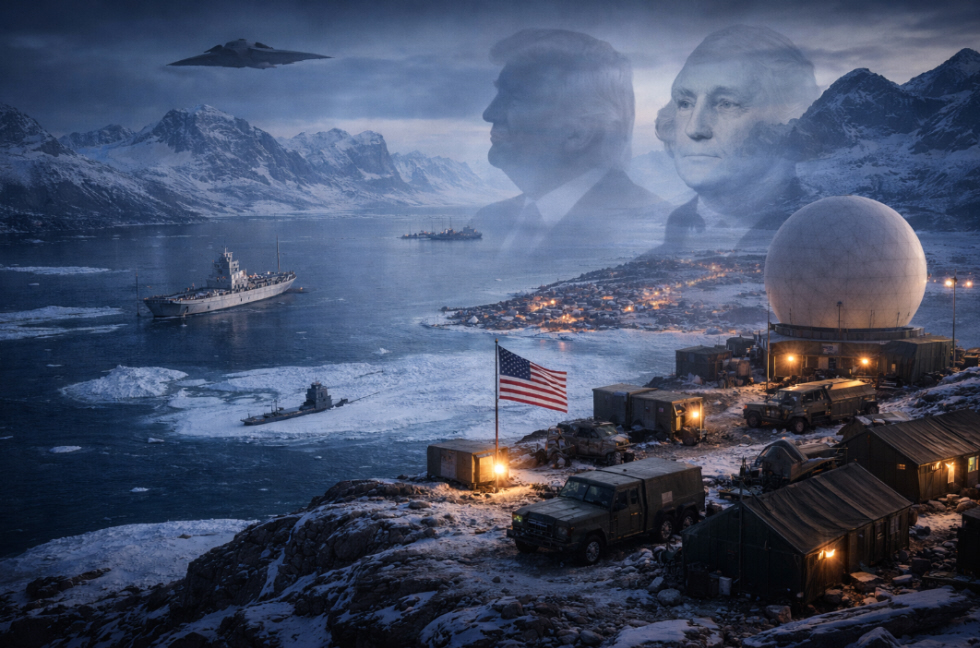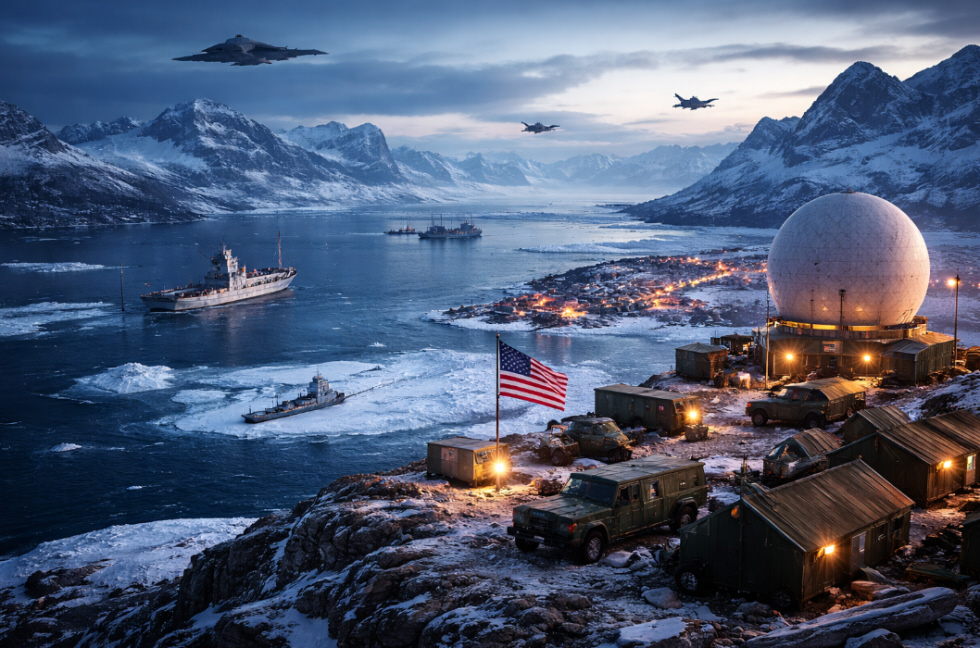
U.S. President Donald Trump has once again placed Greenland at the center of the global geopolitical debate, issuing a clear warning: countries that oppose a stronger U.S. role or control over the Danish autonomous territory could face punitive tariffs. For Trump, this is not a diplomatic or symbolic issue, but a direct matter of national security. From Washington’s perspective, Greenland has become a strategic asset of the 21st century.
As competition with Russia and China intensifies, the Arctic is no longer a remote or secondary region, but a critical frontier for defense, surveillance, and strategic positioning. Greenland’s geography makes it indispensable for missile defense systems, early warning capabilities, and power projection. The firm rejection expressed by Denmark and Greenland’s authorities rests on arguments of sovereignty and NATO cooperation. However, this position collides with an uncomfortable reality: Europe currently lacks the military, technological, and logistical capacity to independently guarantee Arctic security against rival powers that are already expanding their presence in the region.
The recent decision by several NATO members to deploy troops to Greenland, at Denmark’s request, highlights this contradiction. Rather than resolving the strategic dilemma, it exposes the growing militarization of the Arctic and the absence of a unified, long-term European strategy capable of matching the scale of emerging threats. High-level crisis talks in Washington between U.S. officials and representatives from Denmark and Greenland ended without concrete results. The creation of a working group to “explore possible compromises” reflects more a political delay tactic than a structural solution, as the strategic environment continues to deteriorate.
Trump has also refused to rule out the use of force, a position that unsettles U.S. allies but aligns with a longstanding American doctrine: when vital national interests are at stake, ambiguity is minimized. Greenland is not merely a distant territory; it is a critical platform within the Western security architecture. Protests announced in Copenhagen and across Greenland, along with reactions from international actors such as Canada and Russia, underscore the political sensitivity of the issue. Yet diplomatic unease and public opposition do not alter the fundamental reality: the balance of power in the Arctic is shifting rapidly.
Russia has expanded its military footprint across the region, while China openly describes itself as a “near-Arctic power,” investing heavily in infrastructure, research, and strategic routes. In this context, hesitation or excessive reliance on slow-moving consensus mechanisms risks producing a permanent strategic disadvantage for the West. Within the United States, public support for direct military action remains limited, constraining the most extreme options.
Nevertheless, Trump’s push serves another purpose: it forces allies and rivals alike to acknowledge Greenland’s central role in contemporary global security. Beyond the political noise, the message is unmistakable. Greenland is no longer a forgotten periphery but a core element of the emerging geopolitical order. And in that evolving landscape, the United States has made clear it is unwilling to remain on the sidelines—even if doing so generates diplomatic friction, political costs, and an uncomfortable debate over sovereignty and power.