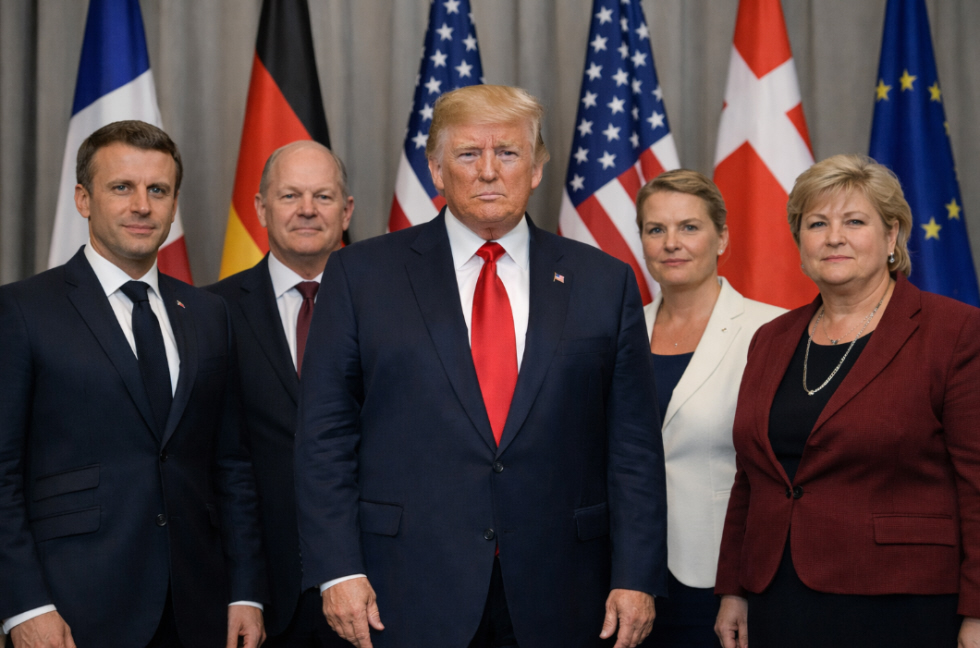
President Donald Trump announced a new round of tariffs targeting imports from eight European countries, escalating trade tensions just one day after warning that nations unwilling to support U.S. control over Greenland could face economic consequences. The decision has quickly drawn international attention due to its geopolitical and economic implications.
According to the White House, the tariffs will take effect on February 1 and apply to goods imported from Denmark, Norway, Sweden, France, Germany, the United Kingdom, the Netherlands, and Finland. Imports from these countries will initially be subject to a 10% duty, with the rate scheduled to rise sharply to 25% beginning June 1. Trump has repeatedly argued that Greenland holds strategic importance for U.S. national security, citing its geographic position in the Arctic and its relevance to military and defense planning.
Greenland is a self-governing territory that remains part of the Kingdom of Denmark, a fact that has complicated diplomatic discussions surrounding the president’s statements. The president’s renewed focus on Greenland has raised concerns among European leaders, many of whom view the tariffs as political pressure rather than a trade-based decision. Several governments have expressed unease over what they describe as the use of economic tools to influence sovereign and allied nations. Economists warn that the tariffs could disrupt established trade relationships between the United States and Europe.
While the measures are officially imposed on imports from foreign countries, the financial cost is typically absorbed by U.S. companies that purchase and bring those goods into the country. Those additional costs are often passed on to consumers in the form of higher prices, potentially affecting a wide range of products across multiple industries. Business groups have cautioned that prolonged tariff policies could increase inflationary pressures and reduce competitiveness for American firms.
European officials have not announced immediate retaliatory measures, but several governments have indicated they are reviewing possible responses. Diplomatic efforts are expected to intensify in the coming weeks as both sides assess the broader impact of the tariffs on economic and political relations. As the February deadline approaches, uncertainty remains over whether negotiations could alter or delay the planned measures. For now, the announcement underscores a growing willingness by the Trump administration to use trade policy as leverage in broader strategic and geopolitical disputes.