The United States has decided to deploy a second aircraft carrier group to the region amid rising tensions with Iran over its nuclear program and ballistic missile development. The move represents a clear signal of military pressure at a delicate moment for stability in the Persian Gulf and the broader geopolitical balance in the Middle East.
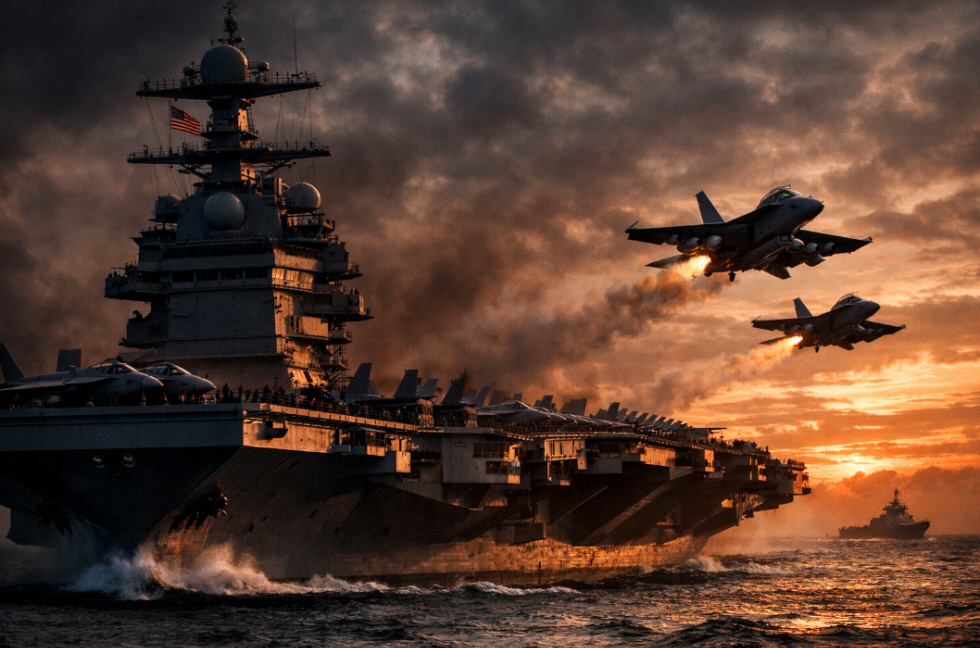
At the center of this new phase is the U.S.S. Gerald R. Ford, considered the most modern and technologically advanced aircraft carrier in the U.S. Navy. With enhanced aircraft launch systems, advanced defense capabilities, and integrated digital technologies, its deployment carries significant strategic weight. The crew of the Ford, which had been operating in the Caribbean, was recently informed of the mission change.
The decision is part of a broader military repositioning strategy aimed at strengthening the U.S. presence in a region where tensions have steadily escalated. In recent weeks, Washington had already increased its footprint in the area with the deployment of the USS Abraham Lincoln, another powerful carrier strike group. The addition of the Gerald R. Ford further elevates the level of deterrence and sends a strong political and military message to Tehran. Beyond the aircraft carriers, the United States has moved destroyers, air defense systems, and fighter squadrons into strategic positions across the Gulf.
The stated objective is to ensure regional stability, protect allied interests, and safeguard international maritime routes. The broader context of this deployment is tied to stalled negotiations over Iran’s nuclear program. Diplomatic differences have intensified, with both sides exchanging warnings about potential consequences if the situation deteriorates further.
For international analysts, the simultaneous deployment of two carrier strike groups is not routine. It represents a demonstration of force designed to reinforce rapid response capabilities in case of any unexpected developments in the region. Iran, for its part, maintains that its nuclear program is intended for civilian purposes, although Western powers continue to express concerns about the potential for strategic weapons development. The tension remains balanced between diplomacy and military deterrence.
The Gerald R. Ford is not expected to return immediately, as it is projected to remain in the region for several months. This extended presence suggests that Washington is preparing for a prolonged period of uncertainty. Meanwhile, the international community is closely monitoring developments. In a global environment already shaped by multiple conflicts and energy concerns, any shift in the Gulf could carry significant economic and political consequences worldwide.