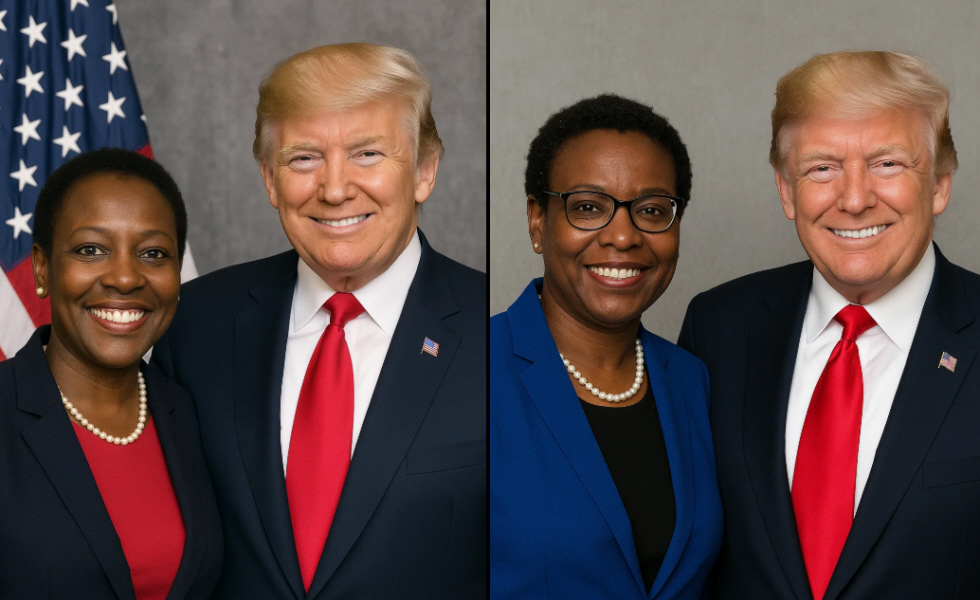
The dismissal of Lisa Cook as Federal Reserve governor has become one of the most controversial episodes in U.S. economic policy in recent decades. Donald Trump announced the measure unilaterally, citing alleged mortgage irregularities, but the decision has triggered an institutional earthquake because never before had a president intervened in the Fed’s structure in this way.
Cook, who in 2022 became the first African American woman to join the central bank’s Board of Governors, immediately rejected the announcement and stated she would remain in her position until the end of her term, set for 2038. Backed by her legal team, the official argues that the president lacks the authority to remove her, since the Fed’s design guarantees the stability of its members precisely to prevent political interference.
The controversy goes beyond the personal and centers on the independence of the central bank. Since its creation, the Federal Reserve has been an institution shielded from partisan swings, with a mandate to make decisions based on economic data rather than electoral convenience. By directly confronting this tradition, Trump seeks not only to mark a difference with Jerome Powell’s policies—who insists on keeping interest rates high to control inflation—but also to pave the way for a board dominated by his allies, who could radically reshape monetary policy.
The political move had an immediate echo in financial markets. Although the initial reaction was moderate, with slight movements in the dollar and Treasury bonds, analysts warn that the real consequence will be international distrust. The possibility of the Fed losing its historic autonomy could weaken the credibility of the U.S. economy in the medium term. On the other hand, the case threatens to result in a prolonged legal battle that could reach the Supreme Court.
There, not only the future of Lisa Cook will be decided, but also the definitive answer to a fundamental question: does a president have the power to shape the Federal Reserve at will, or will institutional independence remain one of the cornerstones of the U.S. economic system? Beyond the judicial outcome, this episode confirms that U.S. monetary policy is at the center of the political battle.
With elections on the horizon and an economic climate still marked by inflation, the clash between Trump and the Federal Reserve could define the economic course of the world’s largest power in the coming years.