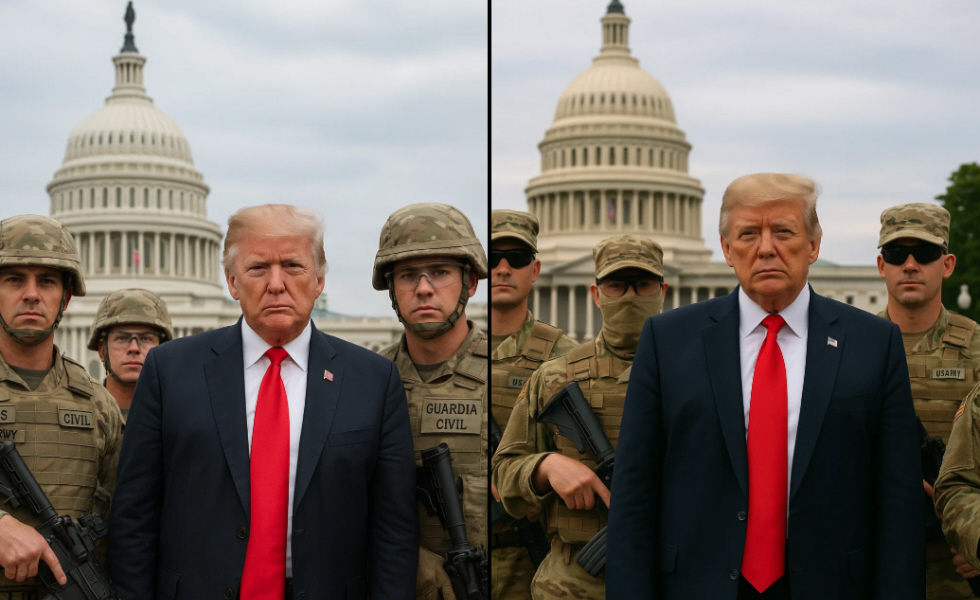
The National Guard deployed in Washington D.C. has officially begun carrying firearms, marking an unprecedented shift in the security policy of the U.S. capital. The order was issued by Defense Secretary Pete Hegseth under the directive of President Donald Trump, as part of what the White House describes as a strategy to “take back control”
in Democrat-led cities with high crime rates. The deployed troops are equipped with M17 pistols and, in some cases, M4 rifles, with instructions to use them only in self-defense or in situations of direct threat.
Nevertheless, the mere presence of armed troops in the streets of the federal district has sparked a heated political and social debate, with accusations that this amounts to a covert militarization of civilian areas.
Trump has justified the measure by arguing that Washington D.C. requires a “swift and forceful” response to what he called an alarming rise in crime, even though local statistics show that crime rates had already begun to decline in recent months. This gap between the presidential narrative and the data has fueled criticism that the move is motivated more by politics than public safety.
Democratic leaders in Congress, mayors of several cities, and civil rights organizations denounced the deployment, saying it violates the principle of local autonomy and creates an unnecessary climate of tension. Several D.C. residents expressed their opposition in peaceful protests, carrying banners with messages such as “We want safety, not militarization.”
At the same time, some conservative sectors praised the decision, arguing that a stronger armed presence in urban areas could serve as a deterrent to potential unrest or violent flare-ups. However, security experts warn that the use of military forces in roles traditionally handled by civilian police could strain relations with the population, erode trust in institutions, and increase the risk of incidents.
This move aligns with Trump’s stated intention to extend similar deployments to other Democrat-led cities such as Chicago and New York, under the same narrative of combating urban crime, although local governors and mayors have already signaled legal and political resistance to block what they describe as an abusive use of military forces.
The future of this measure will largely depend on citizen response, potential judicial rulings, and the federal government’s ability to sustain, both financially and politically, a prolonged National Guard deployment in the nation’s capital.