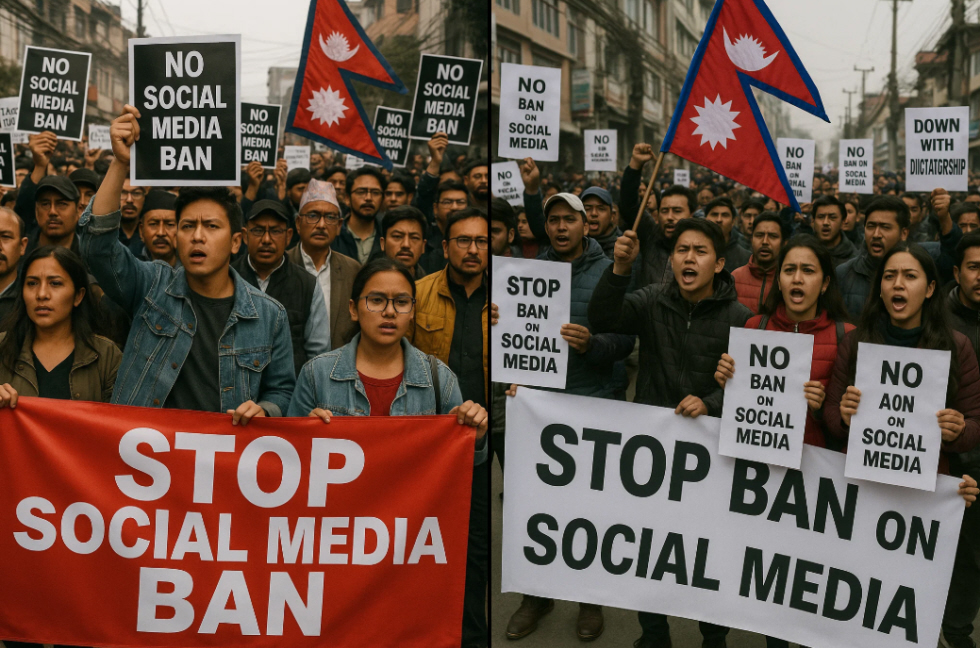
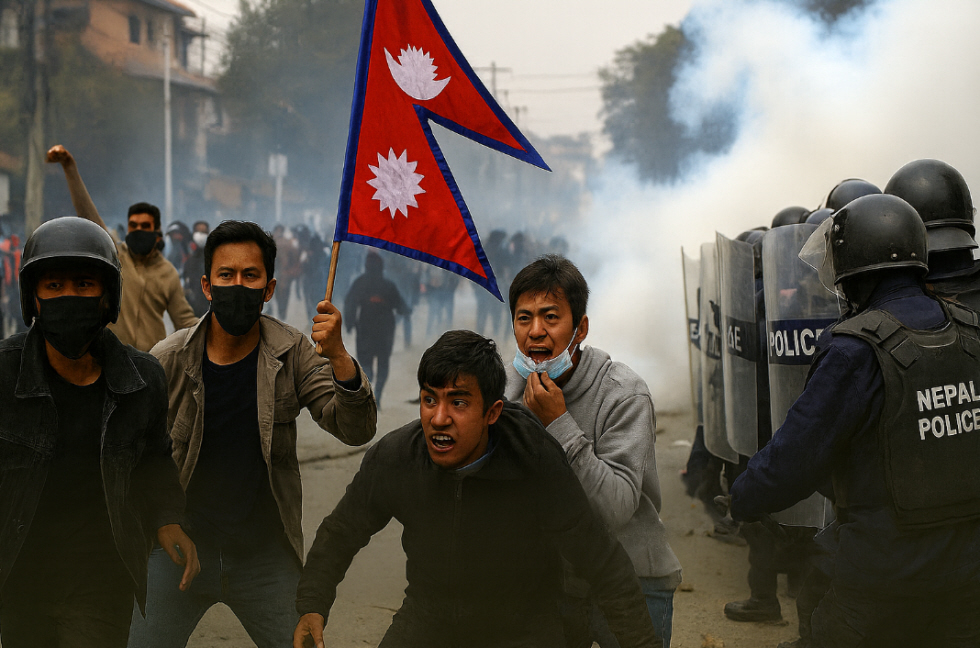
Nepal’s capital, Kathmandu, became the epicenter of massive demonstrations on Monday as protests intensified against the government’s decision to block access to several social media platforms, including Facebook, TikTok, and X (formerly Twitter). According to state media, at least 16 people lost their lives and dozens more were injured after police carried out a heavy crackdown on demonstrators, using tear gas, water cannons, batons, and even rubber bullets.
Television footage showed streets covered in smoke, barricades torn down, and young protesters clashing directly with security forces. Tensions escalated further when thousands of young people, mostly high school and university students, marched toward the national parliament building carrying Nepalese flags and banners reading “Stop corruption, not social media” and “Youth against corruption.”
In their attempt to enter the parliamentary grounds—where demonstrations are legally prohibited—the protesters clashed with police cordons, resulting in violent confrontations. Authorities responded by imposing a curfew around the parliament building, justifying the measure as necessary to preserve security after episodes of unrest. Eyewitnesses reported that some protesters set an ambulance on fire and blocked security force vehicles.
Tensions also spread to other regions of the Himalayan state, where citizens gathered to demand the immediate lifting of the social media ban and stronger measures against government corruption. The backdrop to this crisis lies in the government’s decision, announced last week, to ban online platforms that had not formally registered with Nepalese authorities. The official justification was that social media was being used to spread hate speech, fake news, financial fraud, and cybercrime through fake accounts.
However, much of the population and civil society organizations view the move as a political censorship strategy aimed at silencing criticism in a country where government corruption is seen as widespread and where youth activism, especially on social media, has become central in exposing abuses.
The protests in Kathmandu represent the most significant social challenge faced by the government in recent months. Analysts warn that the violent crackdown could deepen the political crisis and spark a wave of nationwide demonstrations. Meanwhile, the international community is closely monitoring developments, expressing concern over the growing erosion of civil liberties in a country historically fragile in democratic terms.