China’s rapid expansion of its nuclear arsenal has intensified concerns among the United States and its allies, particularly as Beijing now produces more than one hundred nuclear weapons per year and moves toward achieving strategic parity with Washington within the next decade. Although Russia and Iran continue to pose significant nuclear challenges, analysts argue that the most profound and transformative threat is emerging in the Pacific, where China has not only expanded its military capabilities but also demonstrated a far more assertive ambition to project power in the region.
This buildup, combined with the accelerated growth of its strategic forces, represents a seismic shift in the global balance of power that the United States has dominated since the end of World War II and throughout the Cold War. In response, Washington has undertaken an unprecedented reinforcement of its military alliances across Asia, with South Korea emerging as one of its most crucial strategic partners. The United States and Seoul are advancing new defense arrangements that include joint military exercises, enhanced intelligence sharing, and nuclear coordination frameworks designed to preserve stability in the region amid China’s rise and North Korea’s ongoing provocations.
This intensification of cooperation is no coincidence: U.S. policymakers understand that countering China’s expanding influence requires not only maintaining military superiority but also strengthening a network of regional allies capable of balancing Beijing’s ambitions throughout the Indo-Pacific. Japan, Australia, the Philippines, and India form an interconnected system of deterrence in which the United States serves as the central pillar of a new multinational security architecture. Despite China’s impressive military buildup, one strategic reality continues to distinguish the two superpowers: the ability to wage wars far from national territory.
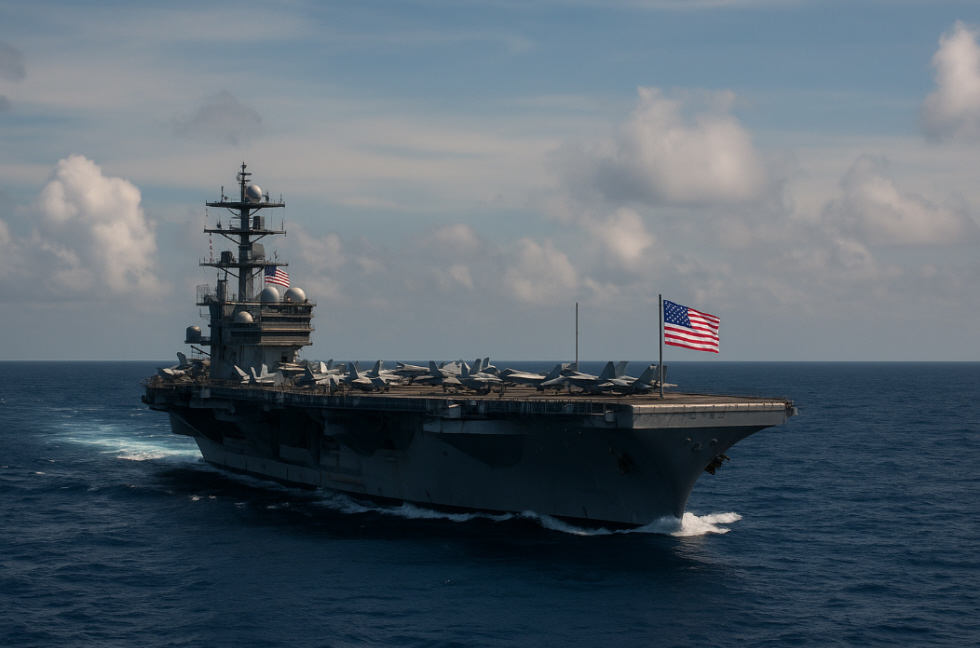
For decades, the United States has been the only nation capable of conducting full-scale military operations abroad, supported by a vast network of global bases, eleven nuclear-powered aircraft carriers, and logistical infrastructure spanning every ocean on the planet. China, by contrast, lacks a comparable international military presence and remains heavily dependent on vulnerable maritime supply routes that the United States could disrupt with relative ease.
This structural gap explains why, despite acknowledging China’s rapid advances, Washington still holds a decisive strategic advantage. The combination of strengthened alliances and unmatched power projection remains the foundation of American military dominance, while China remains confined largely to its regional sphere. In this evolving landscape, the competition will not be solely nuclear or economic, but territorial, technological, and geopolitical—shaping a Pacific region that is steadily becoming the new center of global power.