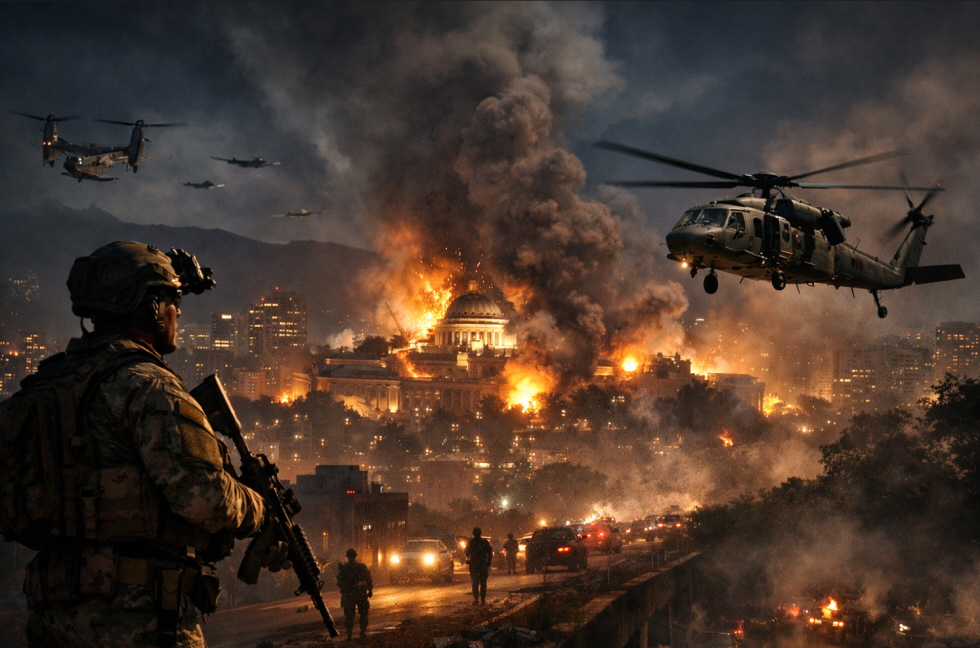
The eyes of the world awoke this January 3, 2026, fixed on Caracas. For months, tensions between the United States and Venezuela had steadily escalated through threats, sanctions, and a strict naval blockade that hinted at an inevitable confrontation. This time, the warnings turned into action. In the early hours of the morning, intense airstrikes shook the Venezuelan capital, marking a historic turning point. While Washington describes the operation as a precise blow against international narcoterrorism, dawn in Venezuela arrived shrouded in smoke, fear, and uncertainty.
At approximately 2:00 a.m. local time, a series of explosions rocked multiple areas of Caracas. Residents reported sequential detonations that caused buildings to tremble and forced thousands to flee their homes in panic. Areas surrounding the La Carlota military airport and the vicinity of the Miraflores Presidential Palace were among the most heavily affected, quickly fueling speculation that the strikes were aimed at the very core of the country’s political and military power. Social media was soon flooded with images showing aircraft flying at low altitude, helicopters hovering over strategic zones, and thick columns of smoke rising from military installations. Within minutes, large sections of the city lost power, deepening the chaos. The Venezuelan government responded by declaring a nationwide state of emergency and denouncing what it called an “imperialist aggression,” while the whereabouts of President Nicolás Maduro became the central question of the day.
Uncertainty intensified when Vice President Delcy Rodríguez appeared on state television demanding a “sign of life” from the president and his wife, Cilia Flores. Their unexplained disappearance for several hours created an unprecedented power vacuum. In the streets, confusion reigned: some citizens cautiously welcomed the possibility of political change, while others feared an even deeper institutional collapse. The narrative shifted sharply soon afterward from the United States. At 4:30 a.m. Eastern Time, President Donald Trump publicly announced that U.S. special forces had captured Nicolás Maduro as part of what he described as a “brilliant operation.”
According to Trump, the Venezuelan leader and his wife had been evacuated from the country under custody, effectively bringing an end—at least formally—to a government Washington had long labeled as criminal. Trump justified the intervention as a necessary action against what he called an international narcoterrorist system. His administration insisted that the operation was not a conventional war, but rather a large-scale law enforcement action supported by military intelligence and security agencies. The president announced a press conference from Mar-a-Lago, even as legal and constitutional questions began to surface in Washington over the absence of a formal declaration of war by Congress. The White House has relied on two main arguments to defend the operation.
First, the classification of the Maduro government as a criminal organization linked to drug trafficking, allowing the action to be framed under an antiterrorism rationale. Second, the political backing derived from November 2025, when the U.S. Senate rejected measures aimed at limiting presidential authority regarding Venezuela, granting Trump broad latitude to act. In Venezuela, meanwhile, the humanitarian crisis deepened. A population already battered by years of hyperinflation, shortages, and widespread poverty poured into the streets without clear information and amid fears of further strikes.
Hospitals operated on emergency generators, communications were disrupted, and security forces were deployed across the capital, defining the first hours of a nation paralyzed between hope for change and the risk of total internal collapse. The international response quickly exposed a deeply divided global community. Some U.S. allies described the operation as a historic opportunity for political transition, while Russia and China warned of dangerous regional destabilization. In Latin America, voices such as Mexican President Claudia Sheinbaum called for an immediate end to the violence. As the day unfolds, Venezuela enters one of the most decisive moments in its recent history, with its future still entirely uncertain.