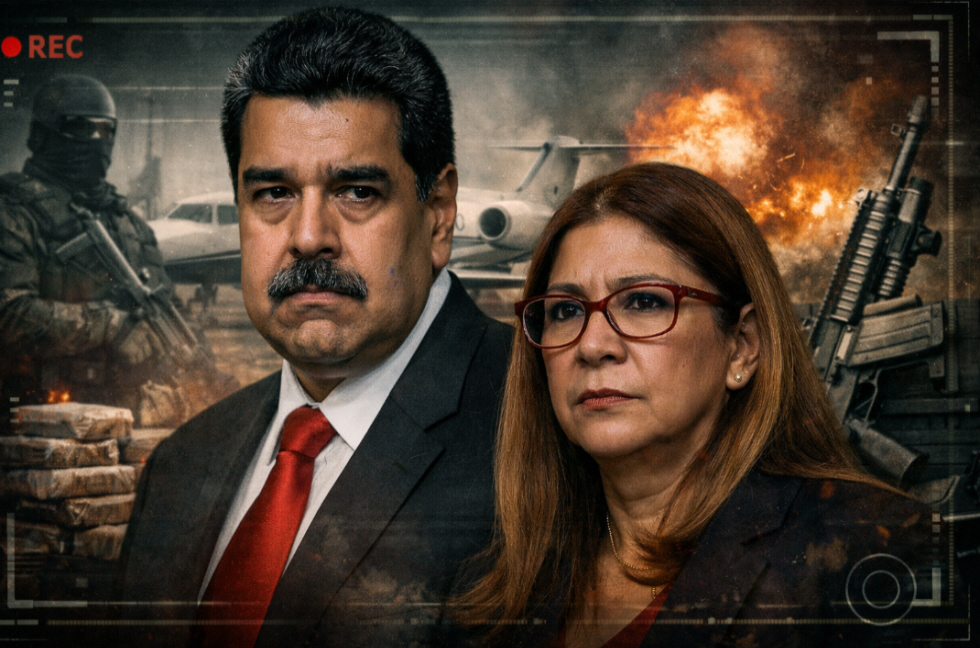
To support the criminal charges against Venezuelan President Nicolás Maduro and his wife, Cilia Flores, U.S. prosecutors say they have spent years assembling a broad body of evidence that includes recordings, informant testimony, and prior court cases. With this material, the prosecution aims to demonstrate the existence of a suspected transnational criminal network that allegedly operated from Venezuela through Colombia and Mexico into the United States, under protection from the highest levels of political power.
According to the indictment, this network was neither incidental nor short-lived, but a long-standing operation with stable ties to armed groups and drug cartels. Prosecutors argue that parts of the Venezuelan state apparatus were used to facilitate drug trafficking and to guarantee impunity for those involved. A key element of the case is the recent guilty plea entered this summer in a New York court by a former high-ranking figure of the regime. That same court will now oversee the criminal proceedings involving Maduro, significantly raising the international and political stakes of the case.
The 25-page indictment names six defendants. In addition to Maduro, those charged include his wife Cilia Flores and his son Nicolás Maduro Guerra, also known as “Nicolasito” or “The Prince.” They are joined by Venezuela’s current interior and justice minister Diosdado Cabello, his predecessor Ramón Chacín, and Héctor Guerrero Flores, identified as one of the country’s most dangerous criminal leaders. Guerrero Flores, 42, is described by U.S. investigators as the leader of the Venezuelan criminal group Tren de Aragua. According to prosecutors, the organization evolved from a prison gang into a “transnational terrorist organization,” expanding its operations across multiple countries and engaging in drug trafficking, extortion, and organized violence.
The indictment includes four main charges: conspiracy to commit narco-terrorism, conspiracy to import cocaine into the United States, possession of machine guns and destructive devices, and conspiracy to possess such weapons. Prosecutors emphasize that the weapons-related charges are directly linked to narco-terrorism and cocaine trafficking, rather than representing a general prohibition on firearms possession. The most serious charge, narco-terrorism, applies only to Maduro, Cabello, and Chacín. If convicted, they could face decades in prison.
For now, however, only Maduro and his wife are in U.S. custody, while the other defendants remain beyond the immediate reach of American authorities. According to prosecutors, the defendants accepted bribes, tolerated or facilitated drug smuggling, arranged diplomatic protection, and supplied weapons to criminal organizations. In the case of Maduro’s son, authorities allege that he even transported cocaine on aircraft. The indictment claims that Cilia Flores received “hundreds of thousands of dollars” in 2007 to facilitate a meeting between an unidentified drug trafficker and the head of Venezuela’s anti-drug agency.
The court document lists 19 specific episodes illustrating these practices. Among them is the case of a Venezuelan National Guard officer, charged separately and currently a fugitive, who allegedly loaded aircraft with cocaine alongside his subordinates. Time and again, prosecutors say, bribes were paid so that drug cartels could conduct their operations without interference. The groups cited in the indictment include Mexico’s Sinaloa cartel, Colombia’s FARC and ELN organizations, the Cartel del Noreste, and Tren de Aragua.
By contrast, the so-called “Cartel of the Suns,” a term often invoked in U.S. political rhetoric, appears only marginally in the formal charges. Nevertheless, recordings included in the case capture conversations involving Maduro’s nephews, who in 2015 met with undercover agents from the U.S. Drug Enforcement Administration. In those recordings, they discussed the possibility of shipping large quantities of cocaine through the presidential hangar at Caracas’s Maiquetía airport and expressed open hostility toward the United States, boasting of their ties to the FARC.
A pivotal role in the investigation is played by former military intelligence chief Hugo Armando Carvajal Barrios, known as “El Pollo.” After being arrested in Spain in 2021 and extradited to the United States three years later, he pleaded guilty this summer to narco-terrorism charges in New York. Shortly afterward, Washington raised the reward for information leading to Maduro’s capture to $50 million, now describing him as the leader of the so-called Cartel of the Suns.
The current indictment differs significantly from the one filed in 2020. At that time, prosecutors focused primarily on links between Venezuela’s military establishment and Colombia’s FARC. In the latest version, investigators extended the alleged criminal period through 2025, shifted priorities, and strengthened the case with new evidence and testimony.
Looking ahead, Maduro and his wife have pleaded not guilty and have not sought bail. According to the New York Times, it could take up to a year before a jury is selected to weigh the evidence for and against the defendants. The defense is expected to challenge U.S. jurisdiction and Maduro’s status as a head of state, setting the stage for a legal battle with far-reaching political and diplomatic consequences.