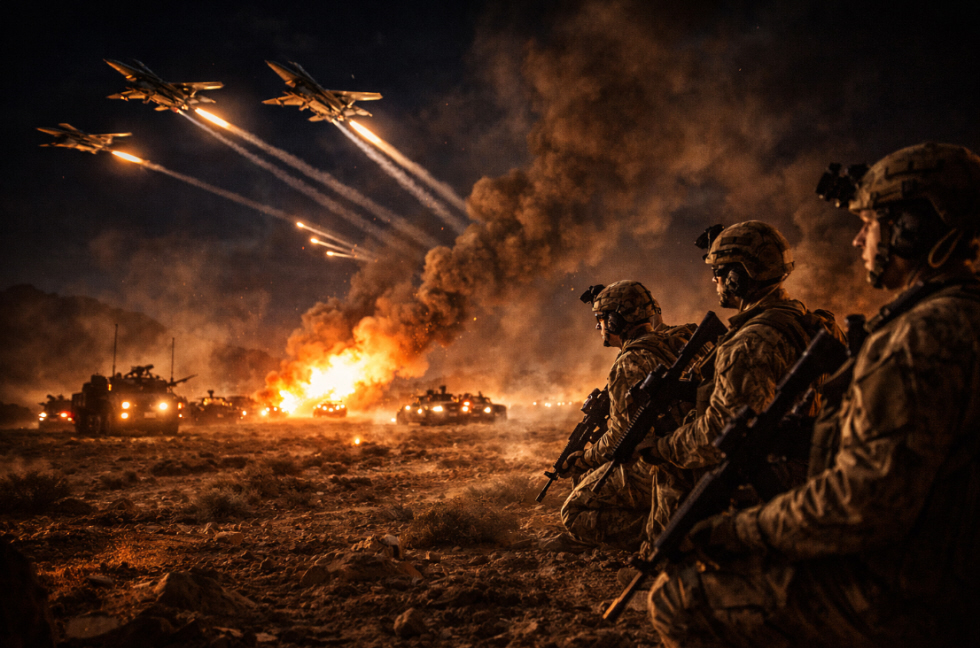
The United States is evaluating a new military escalation in the Middle East that could mark a critical turning point for the region. Sources close to security discussions suggest that up to 10,000 additional troops may be deployed, supported by fighter jet squadrons and armored vehicles. While the decision has not been finalized, it reflects a rising level of strategic tension. The situation is beginning to take shape as a potential large-scale operation.
This possible deployment would add to the forces already mobilized in recent days, including thousands of marines and airborne units. The steady buildup of troops suggests planning that goes beyond a purely preventive measure. It signals a posture that could quickly evolve depending on developments on the ground. The region is closely watching every movement. Within decision-making circles, the possibility of a more direct intervention, including ground operations, is being discussed. Although there is no official confirmation, the mere consideration of this option significantly raises the level of alert.
Decisions in this context carry not only military weight but also political and diplomatic consequences. Each step could reshape the regional balance. The reinforcement with advanced military technology and mechanized units indicates that any operation would be designed for speed and decisive impact. Fighter jets would play a key role in securing air superiority, while ground forces would aim to control strategic positions. This type of deployment points to a comprehensive strategy. It is not a limited action. At the international level, the potential increase in U.S. military presence is generating concern among allies and global actors.
Recent history has shown that moves of this magnitude can trigger chain reactions. Uncertainty is intensifying in a region already marked by underlying tensions. The impact could extend far beyond the immediate area. Meanwhile, markets and strategic sectors are beginning to react to the possibility of escalation. Factors such as oil prices, trade routes, and global financial stability could be affected.
The connection between geopolitics and economics once again becomes evident. Every signal is being closely analyzed by investors and governments. For local populations, the growing military presence represents a mix of uncertainty and fear. Previous conflicts in the region have left deep scars, increasing sensitivity to any troop movements. The prospect of a broader conflict raises concern among already vulnerable communities.
The human dimension remains the most affected. As decisions continue to be evaluated, the world watches closely to see how the situation will unfold. A larger intervention remains on the table, but so does the possibility of diplomatic containment. At this stage, every decision will be critical. The balance between force and negotiation will define what comes next.