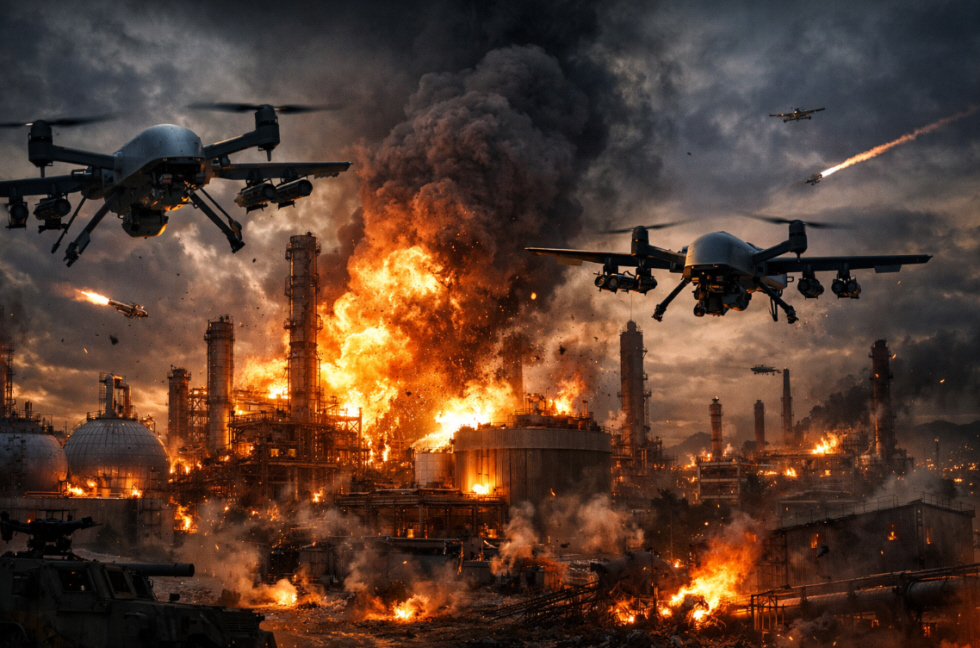
Tensions in the Middle East have reached a new critical point following a direct warning issued by Iran against industrial businesses linked to the United States across the region. The message was clear, urgent, and uncompromising: evacuate immediately. The statement triggered alarm across multiple economic sectors, raising concerns among employees and executives alike. The situation points toward an escalation that could extend beyond the military sphere.
The Islamic Revolutionary Guard Corps delivered the warning through its official communication channels, indicating that facilities connected to U.S. interests could soon become targets. The alert does not differentiate between sectors, widening the scope of potential risk. From logistics hubs to energy infrastructure, everything appears to be under scrutiny. Uncertainty is spreading rapidly. The language used in the statement reflects a sense of immediate urgency, leaving little room for interpretation. All personnel were urged to leave the identified areas without delay. Such warnings carry not only operational consequences but also psychological impact.
Fear is beginning to shape large-scale corporate decisions. Multinational companies operating in Gulf countries have already started activating emergency protocols. Some are evaluating temporary shutdowns to ensure employee safety. Others are considering relocating key assets away from potential danger zones. Corporate reactions are underway, though still fragmented. Financial markets have also responded to the growing threat, reflecting the sensitivity of the current geopolitical environment. Energy and transportation sectors are showing signs of volatility. Investors are closely monitoring every development in the region.
The risk of disruptions to global supply chains has once again become a central concern. At the same time, regional governments are reinforcing security measures around critical infrastructure. Coordination between local authorities and international allies is intensifying. The priority is to prevent collateral damage and protect key facilities. However, the scale of the warning raises questions about containment capabilities. Such warnings are unusual in both their specificity and scope. By directly targeting businesses linked to the United States, an economic dimension is now being introduced into the conflict.
This marks a shift in strategic pressure. The battlefield is no longer limited to military operations. Analysts believe the message is intended to send a strong signal to Washington without triggering an immediate direct confrontation. Targeting economic interests can generate significant indirect consequences. It is a way to expand the conflict’s sphere of influence. And to increase the political cost of escalation. The situation is also placing thousands of expatriate workers in the region on high alert. Many depend on these industries for their livelihoods. The possibility of large-scale evacuations is now being considered.
The human impact could be as significant as the economic one. Meanwhile, key commercial and energy routes remain under constant surveillance. Any disruption could affect global stability within days. Maritime transport and energy exports are particularly vulnerable. The world is watching with growing concern. The announcement also raises questions about Iran’s next move. If the warnings turn into concrete actions, the international response could be immediate.
This would push the conflict into a new and more intense phase. The space for diplomacy appears to be narrowing. In this context, the region enters a stage of maximum uncertainty where every decision carries global consequences. Businesses, governments, and markets are preparing for the unpredictable. Tensions remain at extreme levels. And once again, the world edges dangerously close to a new breaking point.