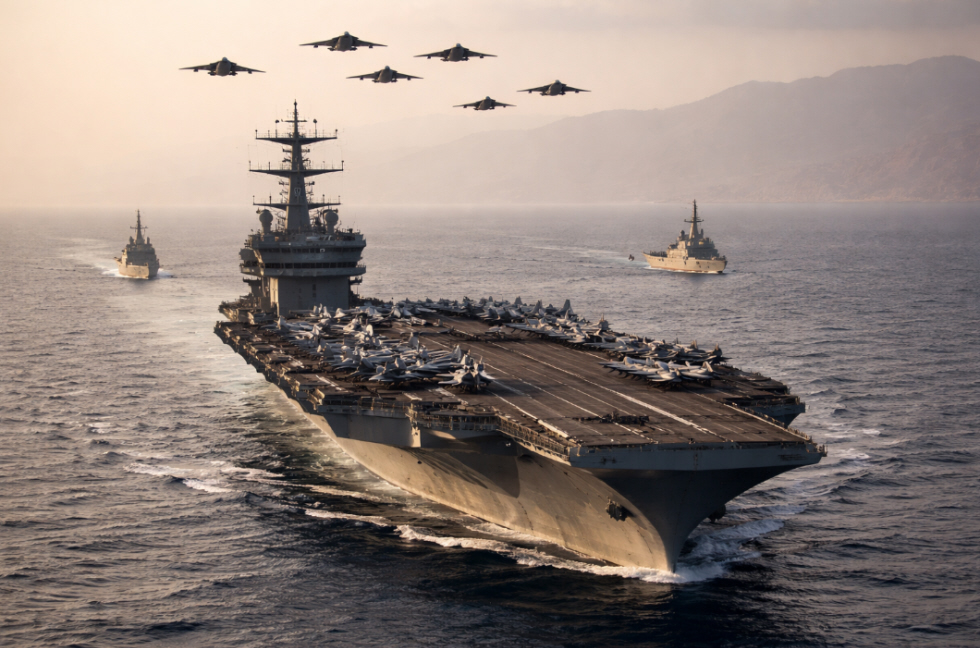
The United States has begun moving military forces toward the Middle East amid rising tensions with Iran. The deployment, confirmed by U.S. officials, is being presented as a preventive measure aimed at strengthening regional security and protecting strategic interests in an area long marked by instability. The movement includes naval assets and advanced defensive capabilities, sent as part of a deterrence strategy against potential hostile actions.
Officials in Washington emphasize that the maneuver does not represent a declaration of war, but rather a clear signal of preparedness and vigilance in the face of growing risks. The decision follows a series of recent developments that have intensified friction between the two countries. Deep disagreements over regional security, military programs, and the role of allied actors have once again placed bilateral relations at a sensitive juncture, defined by mutual distrust. U.S. officials stress that avoiding direct escalation remains a priority, while diplomatic channels are kept open.
At the same time, the deployment reflects a firm stance to respond decisively to any threat against U.S. forces, allies, or critical strategic routes. In Tehran, the move has been met with caution and defiant rhetoric. Iranian authorities reiterate their commitment to defending national sovereignty, warning that an expanded military presence in the region could heighten instability rather than reduce it. The impact of these tensions extends beyond the military sphere. Energy markets, international alliances, and regional political balances are closely watching signals from both Washington and Tehran, aware that any miscalculation could carry global consequences.
Analysts note that such deployments are designed to send multiple messages at once: reassuring allies, warning adversaries, and strengthening the U.S. negotiating position in a complex geopolitical landscape. The challenge lies in maintaining pressure without crossing irreversible thresholds. Domestically, the decision has also sparked debate. Political leaders and segments of public opinion are questioning the cost, risks, and potential duration of an expanded military presence abroad, recalling past experiences that led to prolonged conflicts.
The coming weeks will be critical in determining the direction of events. The actions of both sides, along with any diplomatic gestures, will shape whether the deployment remains a strategic warning or evolves into a more confrontational phase. For now, the movement of U.S. forces toward Iran stands as one of the most closely watched developments on the international stage. In a region defined by fragile balances, every step is being carefully scrutinized, with the understanding that stability depends as much on political restraint as on military strength.