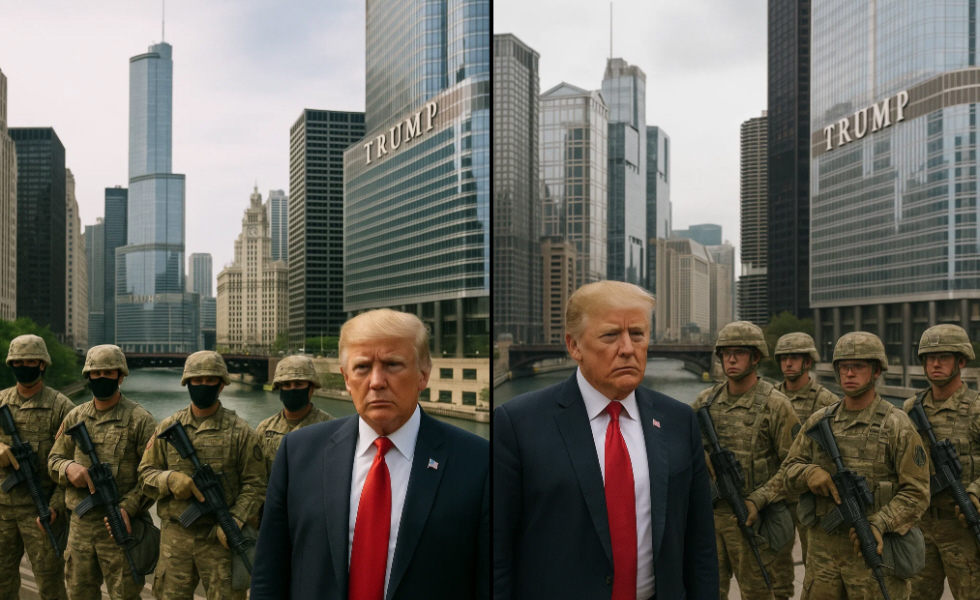
President Donald Trump intensified his long-standing criticism of Chicago this week, labeling it “the most dangerous city in the world, by far,” after a violent Labor Day weekend left at least eight people dead and fifty wounded in a series of shootings across the city. Posting on his social media platform, Trump described the violence as proof of failed leadership and suggested once again that the federal government should step in with stronger measures, including the possible deployment of the National Guard to restore order.
The remarks marked yet another chapter in Trump’s ongoing attacks on Democratic-led cities, particularly those that have struggled with gun violence. Chicago officials were quick to respond. Governor JB Pritzker dismissed the comments as “reckless and unhinged,” stressing that the state has no plans to request military assistance. Mayor Brandon Johnson echoed the pushback, emphasizing that local law enforcement has the responsibility to maintain public safety. Johnson pointed to official data showing that shootings and homicides in Chicago have actually declined in 2025 compared to the same period in 2024, highlighting a 10% drop in overall gun-related crimes.
“The president is ignoring facts to push a political agenda,” Johnson said, underscoring his belief that Chicago is making progress despite persistent challenges. Critics of Trump argue that his statements oversimplify a complex problem while politicizing a painful issue for Chicago residents. They note that while gun violence remains a serious concern, labeling the city as the “most dangerous in the world” is misleading. Crime statistics from other U.S. cities, including several in Republican-led states, show higher per capita homicide rates than Chicago.
Analysts also warn that inflammatory rhetoric risks stigmatizing communities and undermining local efforts to build trust between law enforcement and residents. Supporters of Trump, however, claim his tough language reflects frustration over the city’s inability to curb violence in certain neighborhoods. They argue that extraordinary measures, including federal intervention, may be necessary if local authorities fail to ensure safety. Trump himself has pointed to his use of federal resources during periods of unrest in Washington, D.C., as a model, though legal experts caution that deploying the National Guard without state consent could trigger constitutional challenges.
A recent court ruling in California has already limited such authority, raising doubts about the feasibility of Trump’s threats. Beyond the political rhetoric, the situation underscores the larger national debate over gun violence, urban crime, and the role of federal versus local governments in addressing public safety. For Chicago, the weekend’s violence was another painful reminder of the city’s ongoing struggle with illegal firearms and gang-related activity.
For Trump, it provided another opportunity to position himself as a strongman figure capable of delivering “law and order.” The clash of narratives reflects the polarized nature of American politics, where cities like Chicago often become symbolic battlegrounds in broader ideological wars.