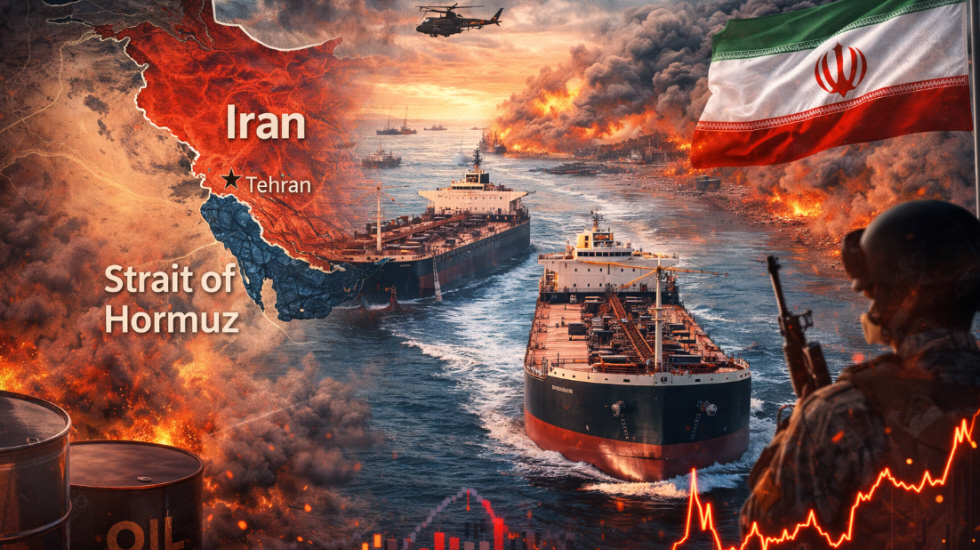
Despite the ceasefire in the region, the Strait of Hormuz remains under strict Iranian supervision, continuing as one of the most sensitive chokepoints in global trade. This maritime passage, vital for oil transportation, is operating under limited conditions. Its partial reopening does not signal normality, but rather strategic control. Tension remains present in one of the key arteries of the global economy.
The first ships have begun to pass through the strait again, though under strict conditions imposed by Tehran. Navigation is not fully open, but carefully regulated by Iranian authorities. Every movement is closely monitored and coordinated. The message is clear: control over the passage remains a tool of power. According to Iranian officials, maritime traffic is subject to what they describe as “technical restrictions.” These conditions include mandatory coordination with the country’s armed forces.
This introduces a direct military element into international commercial flow. The measure raises concern among global stakeholders. Iran’s Foreign Minister, Abbas Araqchi, confirmed that control over the strait will be maintained. His statements reinforce the idea that Iran will not easily relinquish its influence over this strategic route. The official stance highlights the geopolitical importance of the strait. Tehran aims to preserve its dominant position in the area.
The Strait of Hormuz is considered one of the most critical chokepoints in the world. A significant portion of global oil supply passes through it. Any restriction has an immediate impact on energy markets. The stability of supply heavily depends on this narrow passage. The international community is closely monitoring developments in the area. Countries dependent on Middle Eastern oil are watching for any changes in transit conditions. Decisions made around Hormuz can influence prices and supply chains.
Uncertainty continues to pressure global markets. From a strategic perspective, control of the strait provides Iran with a powerful tool of global influence. This is not merely a regional issue, but one that affects economies worldwide. The balance between security and freedom of navigation is becoming increasingly fragile. Oil geopolitics returns to the center of the global stage.
Despite the ceasefire, these measures demonstrate that tensions have not disappeared. Instead, they have evolved into a form of indirect control. Technical restrictions act as a mechanism of pressure. The conflict takes on new forms without fully subsiding. Analysts warn that any incident in the strait could trigger immediate consequences. These range from spikes in oil prices to disruptions in global trade. The fragility of the current balance is evident.
The margin for error is extremely narrow. Looking ahead, the situation in the Strait of Hormuz will remain a key indicator of stability in the Middle East. Iran’s decisions will play a decisive role in global energy flows. Meanwhile, the world watches cautiously. A return to full normality still appears distant in one of the planet’s most critical passages.