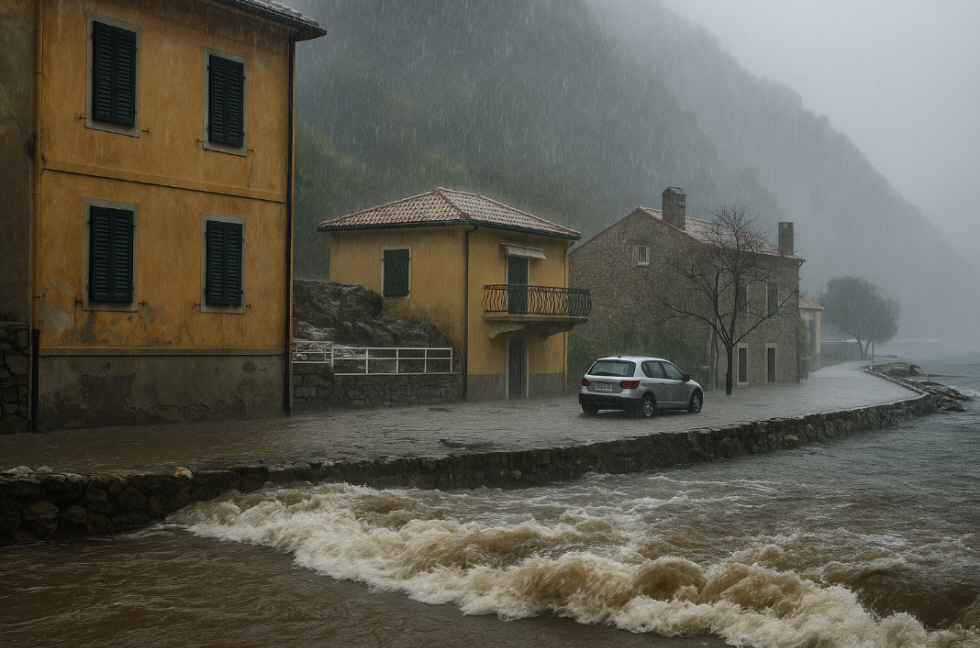
The beginning of autumn in Europe has revealed a striking contrast between the north and the south of the continent. While much of northern Europe enjoys calm and stable weather, countries in the south such as Italy, Croatia, and Greece are currently facing extreme conditions triggered by a powerful low-pressure system. Torrential rains, thunderstorms, and floods are posing a serious threat to residents, roads, and homes.
According to meteorologists, the low-pressure zone is moving over southern Italy, the Croatian coast, and the western Greek islands, producing rainfall exceeding 50 liters per square meter in just 20 to 90 minutes, an extraordinary volume that has placed several regions on high alert. In Italy, the regions of Calabria and Puglia are among the hardest hit, while in Greece, the Ionian Islands of Lefkada, Cephalonia, and Zakynthos, along with the northern Peloponnese peninsula, are facing severe risks from water accumulation.
In these areas, forecasts warn of up to 200 liters of rain per square meter, raising the likelihood of urban flooding, river overflows, and landslides. As a result, streets, basements, and underpasses have already been submerged, while Greek authorities have issued a red-level warning, the highest in their emergency scale. Residents and tourists are urged to stay informed, follow official instructions, and remain indoors whenever possible, avoiding unnecessary travel to the most dangerous areas.
Meanwhile, Croatia is also experiencing weather phenomena of great intensity. Young German storm chaser Luka Berheide documented a spectacular waterspout between Split and Dubrovnik over the Adriatic Sea. The tornado, which amazed many tourists, was captured throughout its life cycle in a time-lapse recording. However, despite the breathtaking images, the situation remains serious: in several Croatian villages, excess water forced manholes to gush and some roads had to be temporarily closed.
In contrast to these extreme weather events, the Alps are already witnessing an unusually early arrival of winter. At altitudes above 2,000 meters, snow has blanketed mountains and landscapes, creating early winter scenery. In Tyrol, up to 20 centimeters of fresh snow were reported, while peaks such as the Großglockner have been covered in white for several days.
In Switzerland, the situation has also forced the temporary closure of key mountain passes such as Susten, Gotthard, Grimsel, and Nufenen. This unusual weather pattern requires hikers and mountaineers to exercise extreme caution, as trekking routes, via ferratas, and mountain crossings above 2,000 meters have become dangerous due to snow and ice. Experts warn that further snowfall is likely in the coming days, confirming the premature arrival of winter in the Alpine region.