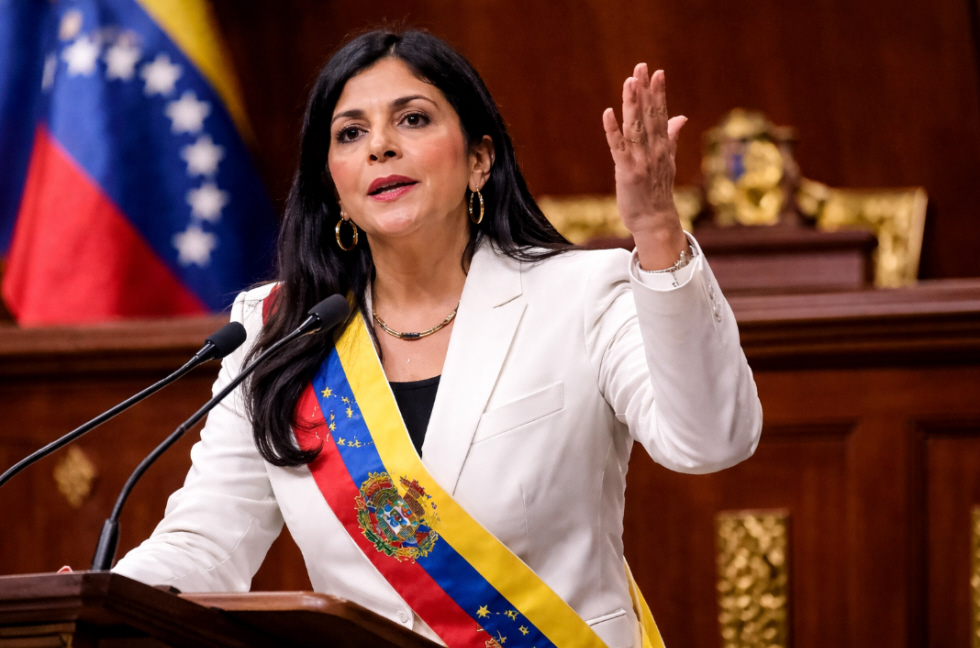
After 27 years in power, Venezuela’s Bolivarian Revolution enters a new phase with the swearing-in of Delcy Rodríguez as interim president, making her the first woman to formally lead the political project founded by Hugo Chávez. The move marks a symbolic moment for Chavismo, which seeks to project continuity and control amid mounting domestic and international pressure. Following the eras of the “supreme commander” Hugo Chávez and the self-styled “people’s president” Nicolás Maduro, the movement now faces the challenge of redefining its narrative.
The official propaganda machine has yet to assign a revolutionary title to the new interim president, an indication that this transition, though anticipated, is not easily absorbed into the mythology of the revolution. At 56, Delcy Rodríguez fits neither the moderate image promoted by sympathetic outlets nor the simplified portrait often drawn in Washington. Her political record and rhetoric suggest she represents not a break with the past, but a firm continuation of Chavismo’s ideological core. That stance was crystallized in a phrase that has followed her for years: “The Bolivarian Revolution, the arrival of our commander, was our personal revenge.”
With those words, Rodríguez revealed a vision of power shaped by confrontation, grievance, and the belief that political authority is a form of historical retribution. Much of that worldview is rooted in her family history. Her father, Jorge Antonio Rodríguez, founder of the Socialist League, died in 1976 while in the custody of the political police. Under Chavismo, he was elevated as a central symbol of human rights abuses before Chávez’s rise, while widespread extrajudicial killings and allegations of torture during the revolution itself were largely ignored.
Delcy Rodríguez and her brother, Jorge Rodríguez, inherited that legacy and turned it into a defining element of their political identity. Within the official narrative, they came to embody the children of a victim of the old system who rose to exact historical revenge against the so-called Fourth Republic. Educated in Paris, the Rodríguez siblings also absorbed a distinctly French cultural influence, reflected in their personal tastes, diplomatic preferences, and public demeanor. Over the years, this influence became visible in both style and lifestyle, often standing in stark contrast to the revolution’s discourse of austerity. That contrast was most clearly exposed by the residence Delcy Rodríguez commissioned in one of Caracas’s most exclusive neighborhoods.
According to investigative reports, the property features advanced security measures, including structures designed to prevent surveillance and electronic monitoring, fueling criticism over privilege and power within the ruling elite. As interim president, Rodríguez assumes a role that extends well beyond protocol. Her position concentrates real political power and places her at the center of internal balances within Chavismo, where rival factions closely monitor each move during a period of institutional fragility. For the government, her swearing-in is presented as a sign of stability and continuity.
For the opposition and much of the international community, it raises questions about legality, duration, and the true scope of authority behind this new leadership arrangement. Beyond the office itself, Delcy Rodríguez symbolizes the evolution of Chavismo into an increasingly closed, family-centered, and hierarchical structure, where ideological loyalty outweighs any genuine attempt at political renewal or national reconciliation.
With her ascent to interim power, the Bolivarian Revolution does not signal change, but rather a reaffirmation of its essence: a project defined by memory of conflict, tight control over the state apparatus, and the conviction that power is a conquest to be defended at any cost.