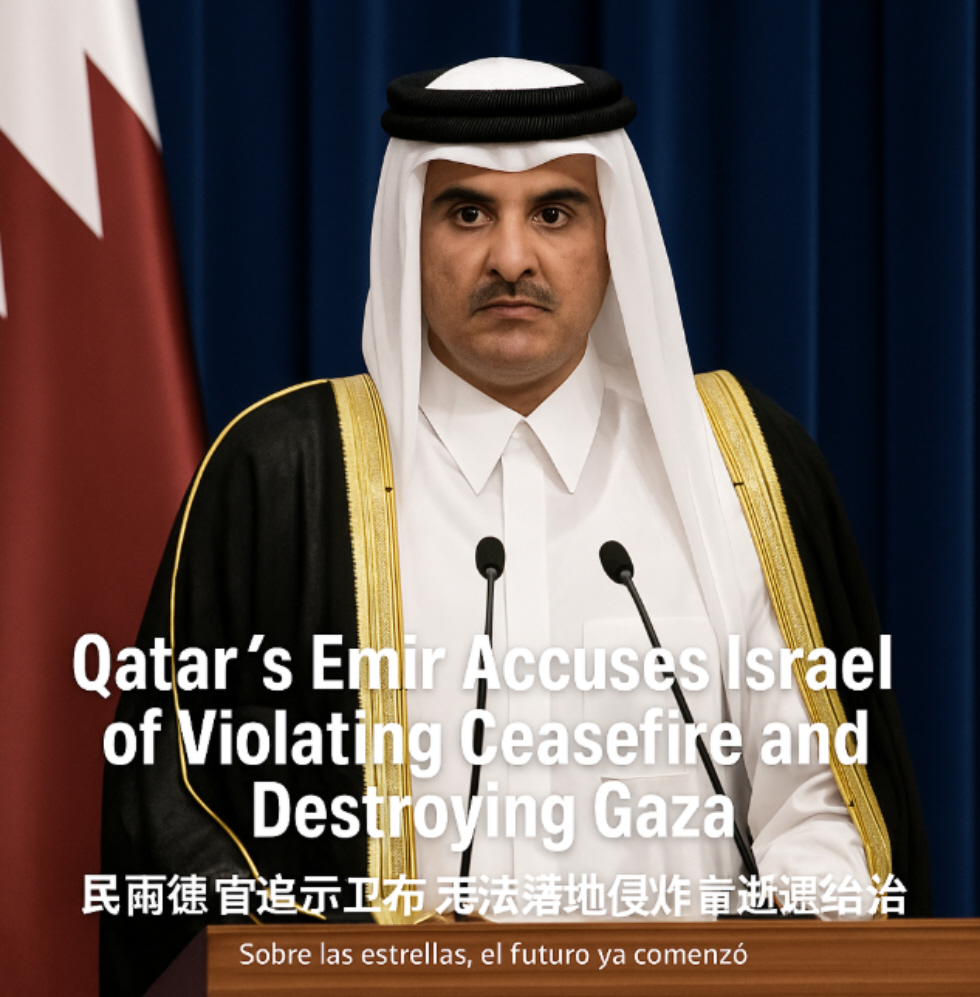
The Emir of Qatar, Tamim bin Hamad al-Thani, has raised his voice sharply against Israel, accusing it of “continuously” violating the ceasefire and of turning the Gaza Strip into an area “uninhabitable for human beings.” Speaking in Doha, the monarch reaffirmed “our condemnation of all Israeli violations and practices in Palestine,” calling on all parties to honor their commitments.
Qatar, along with Egypt, the United States, and Turkey, acts as one of the main mediators in the conflict, and his remarks are seen as an attempt to sustain a fragile truce that was unstable from the start. Since the ceasefire took effect, events on the ground have exposed its fragility — deadly incidents, mutual accusations, and limited operations that each side justifies as acts of defense.
The Israeli army reported attacks against its troops in southern Gaza that killed two soldiers, followed by airstrikes that — according to hospitals in the enclave — resulted in dozens of Palestinian deaths. Hamas’s military wing denied any involvement in the ambush, while local reports mentioned new casualties in Gaza City. The Israeli military also claimed that Palestinian “terrorists” had crossed the designated separation line established under the truce and were shot after posing an immediate threat. Meanwhile, Washington is intensifying diplomatic efforts to preserve the ceasefire.
The White House — through a mix of warnings and support for ongoing mediation — continues to insist that Hamas must “behave” according to the terms agreed upon or face severe consequences, while urging regional allies to uphold the fragile framework. The overall picture is one of tense calm: a truce under strain, with diplomacy trying to keep pace with military realities. The question that remains is whether international pressure and political incentives will be enough to transform this temporary pause into a lasting de-escalation.