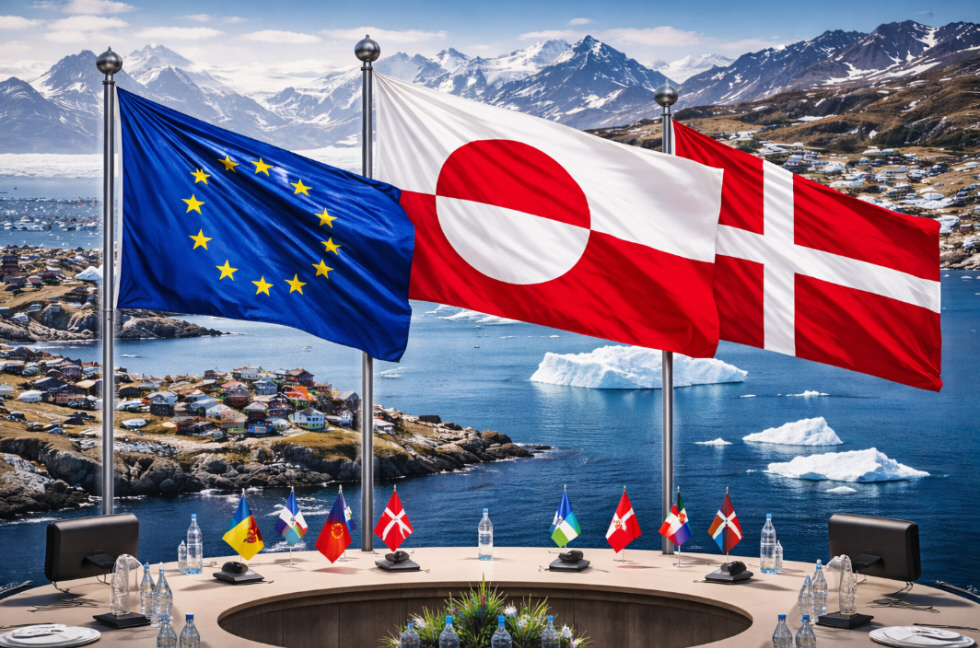
The European Union has decided to close ranks amid rising tensions over Greenland and announced a special summit of heads of state and government to be held on Thursday evening. The meeting aims to define a unified response to recent signals coming from the United States and to reinforce European cohesion at a moment of heightened geopolitical sensitivity. In Brussels, several European leaders stressed the need to act with confidence while avoiding unnecessary escalation.
The central message is to preserve dialogue with Washington, while at the same time preventing any form of pressure that could undermine Greenland’s sovereignty or destabilize the bloc’s economic interests. One of the main concerns among EU officials is the potential imposition of new U.S. tariffs. European authorities warned that a trade confrontation would harm businesses and consumers on both sides of the Atlantic, making diplomacy and de-escalation a priority.
At the same time, the European Union made clear that it possesses defensive tools should the situation deteriorate. These include economic and trade measures that could be activated if the United States proceeds with punitive actions. The objective is to demonstrate readiness to respond without immediately resorting to open confrontation. Solidarity with Greenland and Denmark has emerged as a central pillar of the EU’s position.
European leaders reiterated that the island’s sovereignty and territorial integrity must be respected without exception, signaling that external pressure on this issue would be unacceptable. Political coordination is expected to continue over the coming days in international forums, where European leaders will seek to align positions and strengthen a common stance. Presenting a unified front remains essential to balancing economic strength with diplomatic caution.
In parallel, some member states have floated the idea of acting as mediators to prevent a deeper deterioration of transatlantic relations. These efforts are aimed at easing tensions and identifying negotiated solutions that would avoid long-term damage to trade and cooperation.
The situation surrounding Greenland once again tests the European Union’s unity in an increasingly complex global environment. Brussels now faces the challenge of defending its strategic interests while maintaining stability and dialogue in a relationship that remains crucial to the global balance of power.