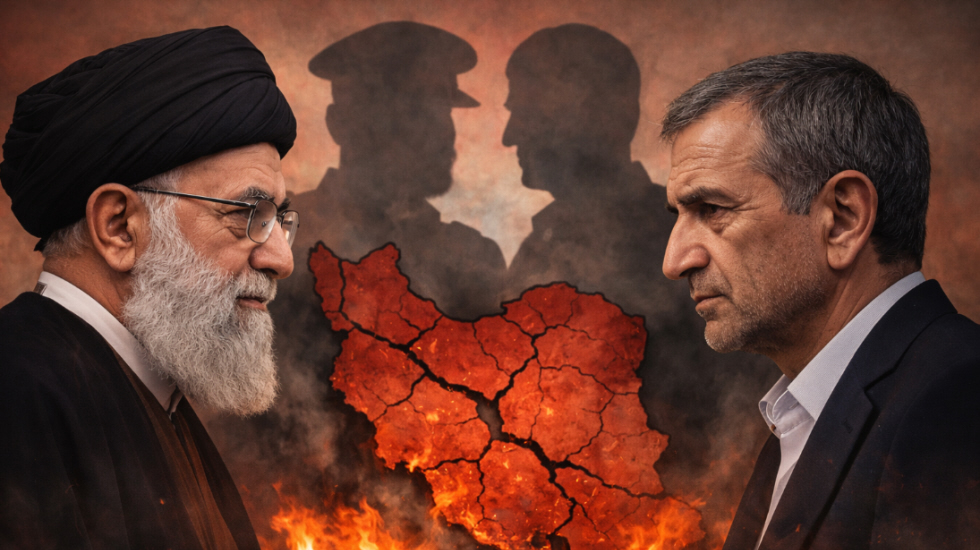
Uncertainty appears to be growing around Iran’s internal power structure as tensions in the region continue to escalate. Recent statements and conflicting reports have raised new questions about decision-making authority within the country. At the center of this debate is the evolving role of key institutions. The situation reflects a complex and fluid political landscape. Earlier in the week, President Donald Trump suggested that negotiations to end the conflict involving Iran could be underway.
He referred to potential counterparts as “more moderate” and “more reasonable,” signaling a possible diplomatic opening. However, Iranian authorities quickly rejected those claims. The contradiction has added confusion to an already tense environment. The gap between public statements from Washington and Tehran highlights the lack of clear communication channels. It also underscores the difficulty of verifying diplomatic developments in real time. In moments of crisis, narratives often diverge sharply. This dynamic complicates efforts to assess the true state of negotiations. At the same time, attention has turned inward, toward Iran’s internal balance of power.
Reports circulating in recent days suggest that the Islamic Revolutionary Guard Corps may be playing an increasingly influential role. While such claims remain difficult to independently confirm, they have intensified speculation. The question of who holds operational control has become central. Iran’s political structure has long been characterized by overlapping authorities. Civilian leadership and military institutions operate within a complex framework.
In times of stability, this system can function with relative balance. Under pressure, however, those dynamics can shift more visibly. If internal competition is indeed increasing, it could affect both domestic stability and external posture. Decision-making processes may become less predictable. This uncertainty can influence how other nations interpret Iran’s actions. In high-tension environments, perception is often as important as reality. The role of the IRGC has historically extended beyond military functions. It has influence in strategic, economic, and security matters.
Any perceived expansion of its authority would therefore carry broader implications. Observers are closely watching for signals that confirm or contradict these reports. Meanwhile, the absence of confirmed negotiation channels raises additional concerns. Diplomatic ambiguity can create space for miscalculation. Without clear communication, tensions may escalate unintentionally.
This risk becomes more pronounced as multiple actors remain engaged in the crisis. International reactions have so far been cautious, reflecting the uncertainty surrounding the situation. Governments are likely assessing both the credibility of reports and the potential consequences. The evolving narrative requires careful interpretation. Premature conclusions could distort the broader picture.
In this context, the question is not only about who leads within Iran, but how that leadership translates into action. The coming days may provide greater clarity on internal dynamics. For now, the situation remains fluid. And in a region already under strain, uncertainty itself becomes a critical factor.