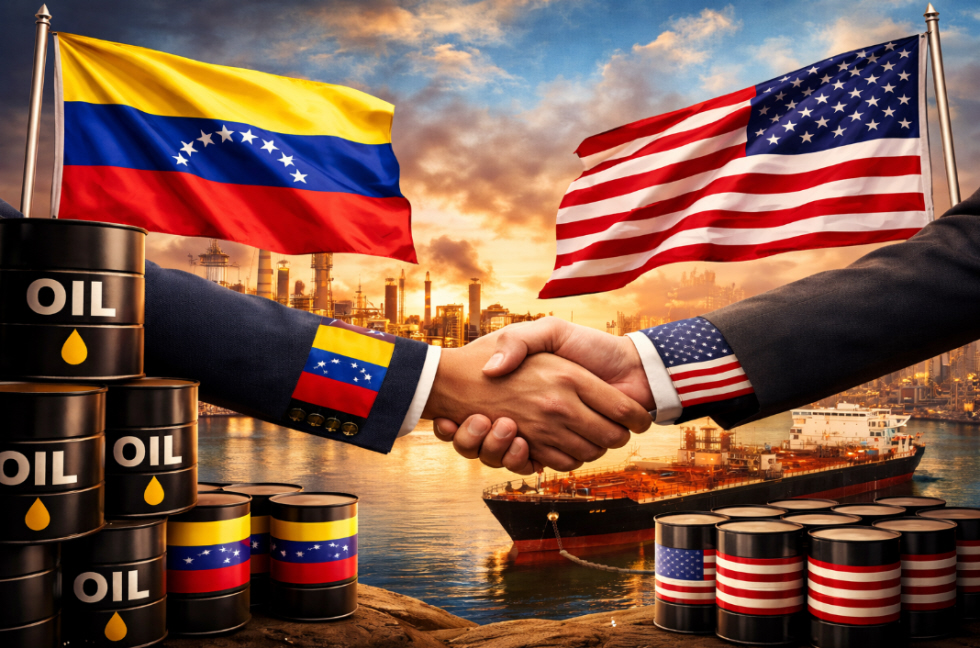
The President of the United States, Donald Trump, announced that Venezuela’s interim authorities have agreed to transfer between 30 and 50 million barrels of crude oil to the United States, in a move that represents a major shift in the political and energy relationship between the two countries. According to the president, the oil will be sold at market price, and the revenues generated will be administered by the U.S. government with the stated goal of benefiting both the Venezuelan and American people.
Trump said the transfer is part of a new framework of cooperation following recent political developments in Venezuela. He emphasized that his administration will maintain direct oversight of the process to prevent the misuse of funds and ensure transparency, arguing that the revenues will not be diverted into corruption or political structures unrelated to public interests.
The initiative, he said, is intended to stabilize energy flows and establish a fundamentally different economic relationship than in previous years. The agreement would prioritize Venezuelan heavy crude, a type of oil particularly well suited for several U.S. refineries, making the operation strategically valuable for the American energy sector. Officials familiar with the discussions indicated that the transfer could help reduce reliance on other suppliers and strengthen U.S. energy security at a time of global uncertainty and heightened geopolitical tensions.
At the same time, the White House has begun discussions with executives from major oil companies to assess logistics, transportation, and the broader impact of the deal on regional production. These talks aim to evaluate short- and medium-term scenarios, as well as define the role private companies may play in refining and processing Venezuelan oil once it reaches U.S. territory. The announcement has triggered mixed reactions both inside and outside Venezuela.
While some see the move as a potential economic opportunity and a step toward recovery for the South American nation, others warn that transferring such a large volume of oil raises serious questions about sovereignty, control of natural resources, and the future direction of Venezuela’s international alliances. Analysts agree that the operation goes far beyond a commercial transaction.
The transfer of up to 50 million barrels represents a significant geopolitical maneuver, with direct implications for Latin America, global energy balances, and Venezuela’s role on the international stage. Its ultimate impact will depend on how the country’s internal political situation evolves and on the agreements that take shape in the months ahead.