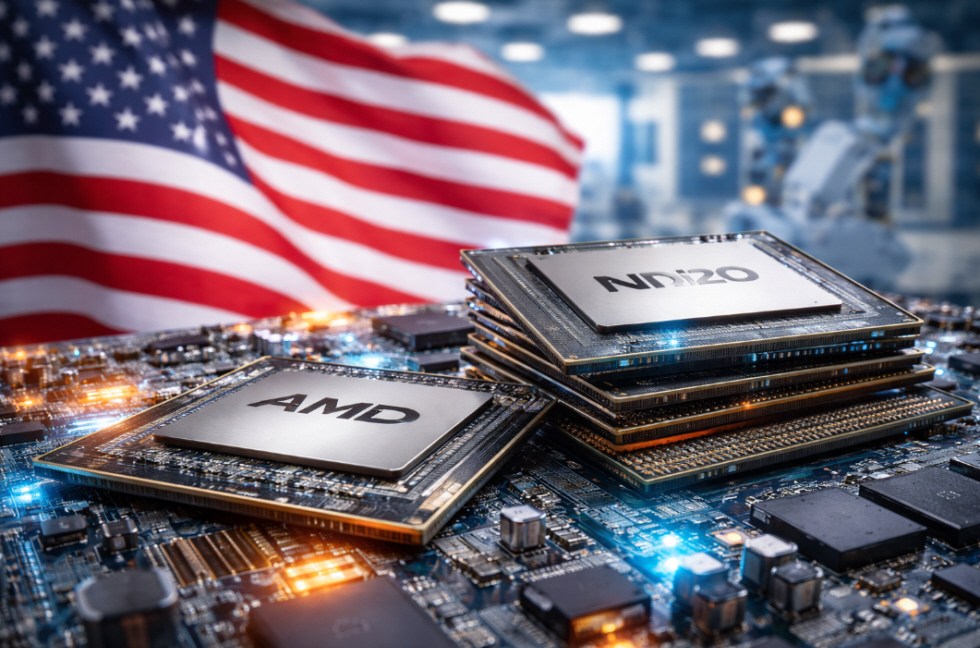
U.S. President Donald Trump has announced the imposition of 25 percent tariffs on certain advanced computer chips, marking a new step in his administration’s effort to strengthen national security and reduce technological dependence on foreign suppliers. The decision was formalized through official documents issued by the presidential office. Among the affected products are some of the most advanced processors currently on the market, including Nvidia’s H200, designed for artificial intelligence applications, and AMD’s MI325X, widely used in high-performance computing.
These semiconductors play a critical role in AI development, data analytics, and advanced computing systems. The White House justified the move by citing the United States’ heavy reliance on foreign supply chains, particularly in Asia. Officials pointed to the concentration of chip manufacturing in countries such as Taiwan, where companies like TSMC dominate the production of cutting-edge semiconductors. According to the administration, the United States currently produces only about ten percent of the chips it consumes, leaving the country vulnerable to geopolitical tensions, trade disputes, and supply chain disruptions.
The new tariffs are intended to encourage the relocation of semiconductor manufacturing to U.S. soil. At the same time, the order includes specific exemptions. Imports destined for U.S.-based data centers, technology start-ups, and civilian industrial applications will not be subject to the tariffs, a measure designed to limit immediate disruption to innovation and domestic technological development. Although American companies such as Nvidia, AMD, and Intel lead the world in chip design, the vast majority of their manufacturing remains overseas.
This gap between design leadership and production capacity has been a central argument behind the administration’s push to reshape trade policy in the technology sector. The tariffs are part of a broader series of actions taken in recent months. In September, Trump announced new tariffs on pharmaceutical products and trucks, and in April he launched investigations into other strategic imports as part of a broader effort to revitalize domestic industry.
With this decision, the Trump administration underscores its commitment to technological reindustrialization amid intensifying global competition and geopolitical uncertainty. The long-term impact of the tariffs, however, will depend on how quickly the United States can expand its domestic semiconductor manufacturing capacity and adapt its supply chains.