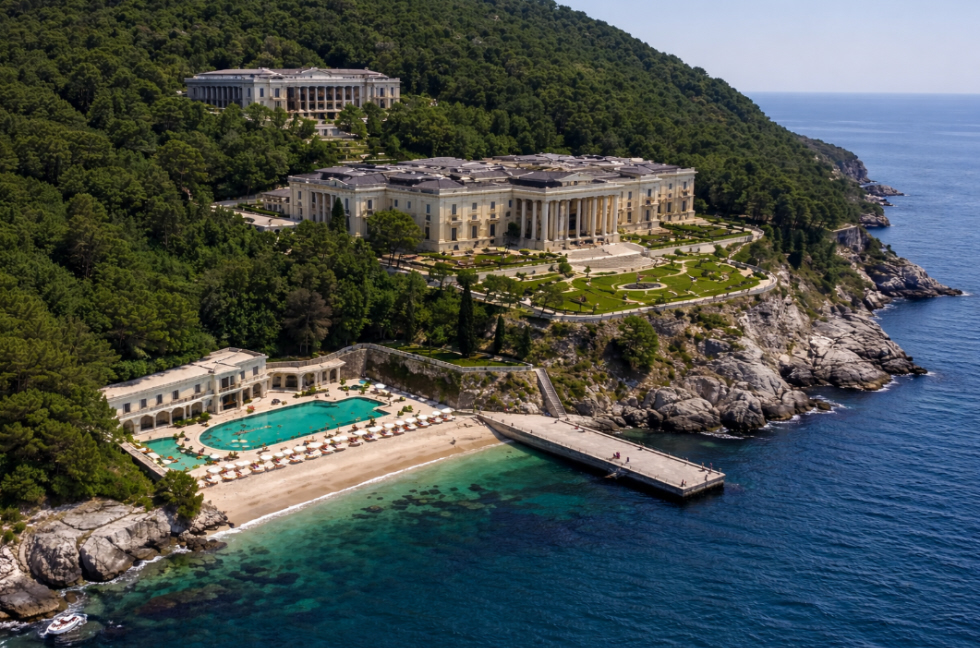
Russian President Vladimir Putin is alleged to have acquired a new palace, this time located in Crimea, according to an investigation published by the Anti-Corruption Foundation (FBK) founded by late opposition leader Alexei Navalny. For years, reports of luxurious country estates linked to Putin have circulated widely, with well-known examples including the Gelendzhik palace and the Valdai complex. The new findings, however, point to a property that rivals or surpasses those residences in scale and extravagance. According to the investigation, the estate is situated at Cape Aya, a remote and heavily secluded area built into a mountainous coastal slope.
The complex reportedly includes a main residence covering approximately 9,000 square meters, along with a secondary concealed structure measuring around 5,000 square meters. The property features a private promenade, an exclusive pier, and an artificial white-sand beach, as well as a newly constructed helicopter landing pad positioned higher up the hillside.
Photographs released by Navalny’s team depict interiors described as lavish even by Putin’s own standards. Expensive materials, oversized chandeliers, and curated artwork dominate the spaces. One of the main bedrooms reportedly spans 154 square meters and is accompanied by a 50-square-meter bathroom. According to the foundation, a golden staircase and gold railings lead to a gold-plated jacuzzi, allowing its occupant to relax while watching Russia’s state-controlled Channel One television network. The estate appears to extend far beyond residential use.
The complex allegedly includes a private hospital, a cinema, a wellness area with a swimming pool, a billiards room, a wine cellar, a large aquarium, and even a cryogenics room. A separate guest house reportedly contains four oversized bedrooms, along with a beauty salon, gym, and bar, reinforcing the image of a self-contained luxury retreat designed for long-term stays. Before Russia’s annexation of Crimea, the property was reportedly purchased in 2007 by the family of former Ukrainian President Viktor Yanukovych, who later denied any involvement in its construction. Following the annexation, local officials suggested the unfinished estate could be transferred to Russian authorities.
Over time, it allegedly came under the management of Russia’s presidential property administration, according to earlier reports. The Anti-Corruption Foundation claims the estate was later taken over through a network of companies linked to oligarchs within Putin’s inner circle, a method the organization says is routinely used to conceal ownership.
The Valdai complex, for example, is officially registered under the names of the Kovalchuk brothers, long-time Kremlin allies. “Why does Putin keep needing another palace? How many palaces does one person really need?” the foundation asks, highlighting the stark contrast between such luxury and the economic reality faced by millions of Russian citizens.