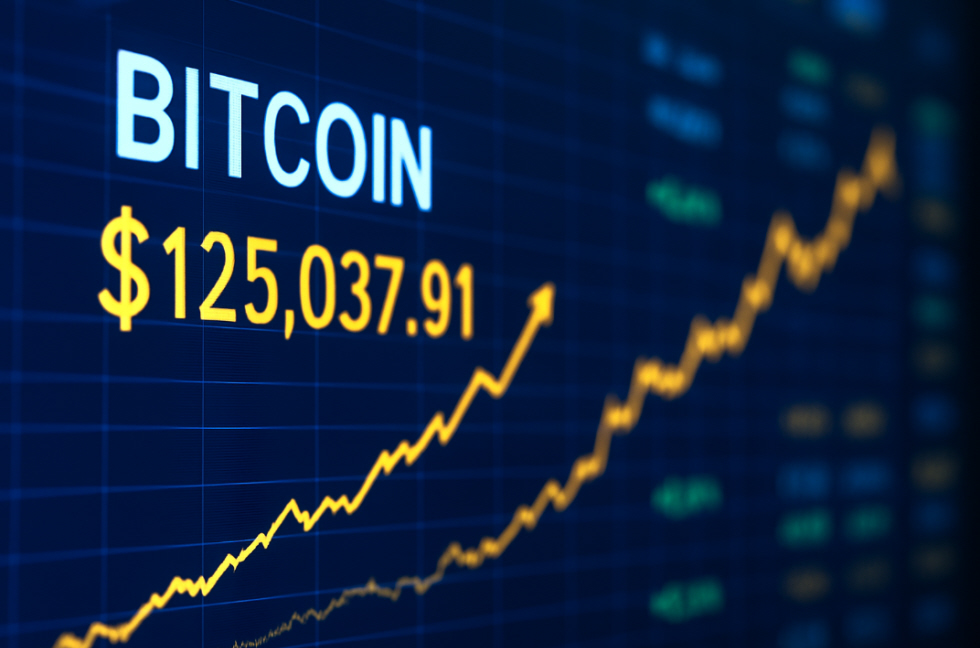
The global financial spotlight is once again focused on the cryptocurrency market as Bitcoin, the world’s oldest and most recognized digital currency, has reached a new all-time high, surpassing the $125,000 mark for the first time in its history. According to data from the trading platform Bitstamp, Bitcoin briefly peaked at $125,426 USD before stabilizing slightly below that level later in the day.
Despite a minor correction, this milestone marks one of the most significant achievements for the crypto sector in 2025, reigniting investor optimism across global markets. Financial analysts point to a mix of macroeconomic drivers and market-specific dynamics behind this latest surge. Institutional investment continues to play a pivotal role, as more hedge funds, asset managers, and multinational corporations integrate Bitcoin into their portfolios.
This growing participation from major investors has strengthened market confidence, even as some early adopters take advantage of the rally to lock in profits. Another key factor fueling Bitcoin’s ascent is the expectation of further interest rate cuts by the U.S. Federal Reserve. In an environment of lower interest rates, traditional savings and bond yields become less attractive, pushing investors toward riskier assets with higher potential returns.
Bitcoin, often dubbed the “digital gold,” has thus regained its appeal as both a speculative vehicle and a hedge against monetary uncertainty. The political tensions in Washington have also contributed to Bitcoin’s momentum. Budgetary gridlock and renewed concerns over a potential government shutdown have triggered nervousness in traditional markets, leading many investors to diversify into alternative assets such as gold and cryptocurrencies.
As a result, both physical and digital safe havens have rallied in tandem over the past weeks. Beyond macroeconomics, the rally is also being supported by historical market behavior. Within the crypto community, October has earned the nickname “Uptober” — a month that, since 2013, has consistently produced positive returns for Bitcoin in all but two years (2014 and 2018).
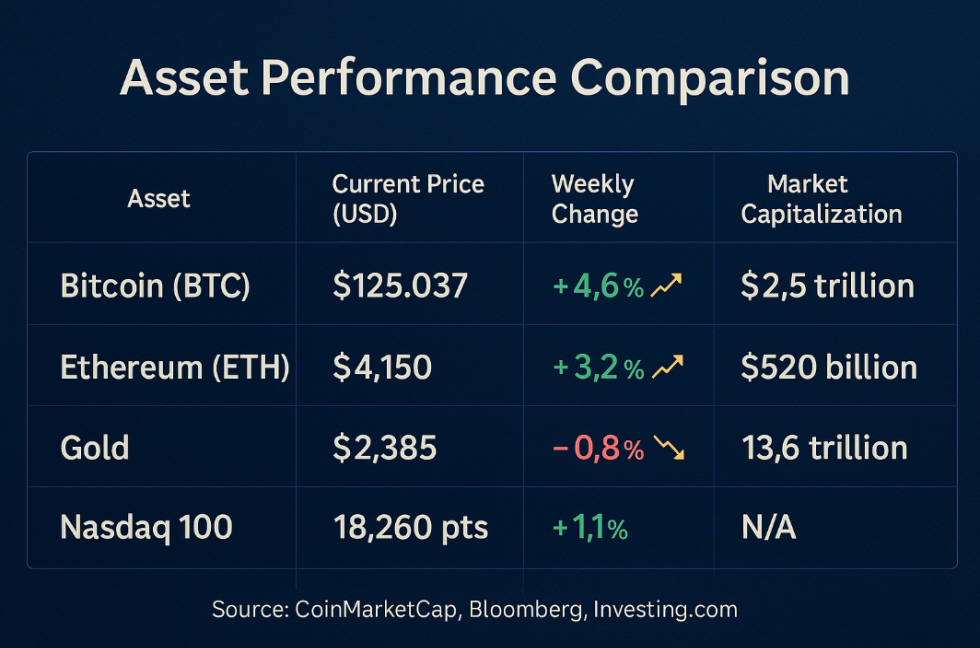
This seasonal trend, combined with strong technical momentum, has reinforced bullish sentiment among traders and long-term holders alike. According to data from CoinMarketCap, Bitcoin’s market capitalization now exceeds $2.5 trillion, reaffirming its dominant position in the digital asset ecosystem. The total value of the global cryptocurrency market has climbed to around $4.3 trillion, underscoring the sector’s steady expansion and growing legitimacy within mainstream finance.
Still, experts urge caution. The volatility of the crypto market remains high, and any unexpected shift in monetary policy or investor sentiment could trigger sharp pullbacks. Yet, compared to previous cycles, many analysts argue that the current rally is built on stronger foundations — supported by institutional adoption, technological advancement, and regulatory maturity in key jurisdictions.
The latest price surge not only solidifies Bitcoin’s status as a cornerstone of the modern digital economy but also signals a broader transformation in global finance. For many, Bitcoin is no longer merely an experiment in decentralized technology; it is now a structural pillar of the new financial era, where innovation, scarcity, and trust are being redefined on the blockchain.