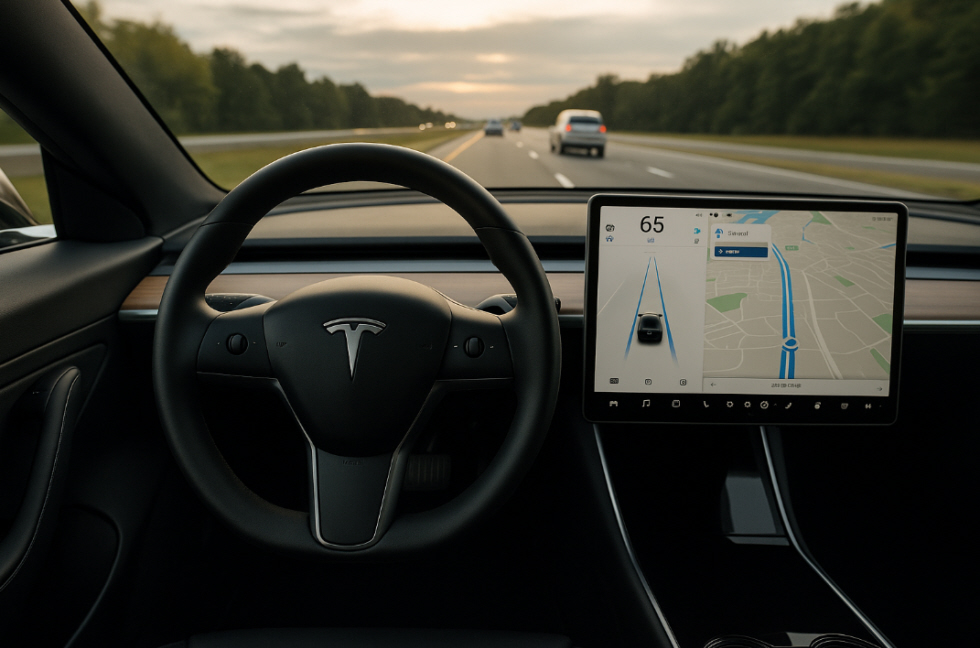
Washington, October 10, 2025 — Tesla’s ambitious yet controversial driver-assistance technology, known as “Autopilot,” is once again under federal investigation by the U.S. National Highway Traffic Safety Administration (NHTSA). Regulators are now focusing on the most advanced version of the software, “Full Self-Driving” (FSD), amid growing safety concerns and a series of recent incidents. According to the NHTSA, the ongoing probe seeks to determine whether Tesla’s system meets minimum safety requirements for vehicles operating on public roads.
The investigation was reopened after multiple reports of collisions involving cars with the FSD feature enabled. Innovation at the Edge of Risk Tesla’s Full Self-Driving mode, offered as an optional software upgrade for its newer models, allows vehicles to navigate highways, execute lane changes, make turns, and respond to traffic signals with minimal driver input. The company promotes FSD as a revolutionary step toward full automation — yet officials say the technology may still rely too heavily on human oversight. “Tesla continues to market this system as fully autonomous,” said a spokesperson for NHTSA, “but our findings indicate that driver supervision remains essential for safe operation.
” A History of Regulatory Tension This is not the first time Elon Musk’s company has faced scrutiny over its self-driving technology. Since 2021, Tesla has been the subject of more than a dozen federal investigations, many linked to accidents involving emergency vehicles or pedestrians while Autopilot was engaged. Tesla defends its system as statistically safer than human drivers, citing internal data showing a lower accident rate per mile when Autopilot is active. Still, critics argue that Tesla’s marketing language may be misleading, giving drivers an exaggerated sense of autonomy and security. Between Innovation and Accountability Experts note that Tesla’s case illustrates the growing gap between technological innovation and regulatory preparedness.
While the company pushes the boundaries of automation, the absence of clear federal standards for self-driving cars leaves regulators struggling to keep pace. “Technology is evolving faster than the law,” said smart mobility analyst Karen Mendez. “The real question isn’t whether cars can drive themselves — it’s whether we’re ready to let them.” Software Updates and Ongoing Controversy In response to the investigation, Tesla announced a new software update that aims to improve pedestrian detection, signal recognition, and lane discipline in urban environments.
The company also reaffirmed its commitment to working with U.S. regulators to enhance safety protocols. Nevertheless, the controversy continues to divide experts and the public alike. To supporters, the FSD system represents the next leap toward autonomous mobility. To skeptics, it’s an open experiment conducted on public roads, with human lives as the variable.
As the probe unfolds, Tesla stands at a crossroads between innovation and responsibility — and once again, the world is watching to see whether the future of driving will be guided by artificial intelligence or human caution.