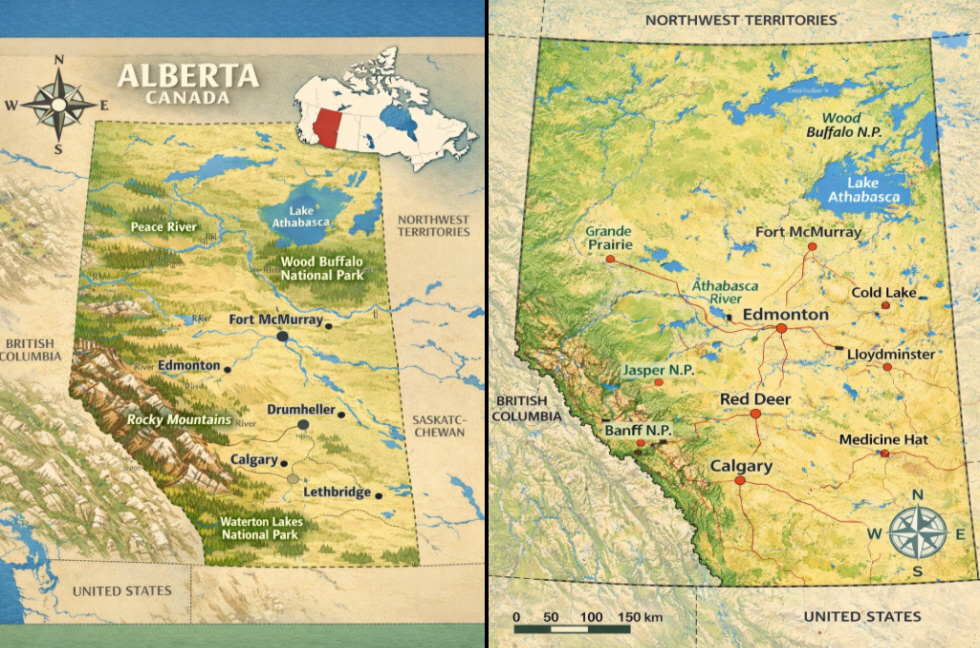
Alberta has emerged as a region of growing strategic interest to the United States due to its concentration of energy, mineral, and agricultural resources. Located in western Canada and sharing a direct border with the U.S. state of Montana, the province occupies a critical position within North America’s economic and geopolitical landscape. The primary factor behind this interest is oil. Alberta holds one of the world’s largest proven reserves, largely in the form of oil sands. These reserves place the province among the top three global holders of petroleum resources and make Canada one of the United States’ most important energy suppliers.
In addition to oil, Alberta is a major producer of natural gas, a resource essential for industrial use and electricity generation. Despite the global energy transition, natural gas remains a strategic “bridge fuel” for Washington, offering reliability while reducing dependence on politically volatile regions. Another increasingly important element is critical minerals. While Alberta is not a global leader in rare earth elements, it contains deposits of lithium, nickel, cobalt, and uranium—materials vital for batteries, advanced technologies, and defense industries. For the United States, securing alternative supply chains outside China is a growing strategic priority.
The province also plays a significant role in agriculture. Alberta’s vast arable land supports large-scale production of grains, canola, and beef, reinforcing its importance in regional food security. As climate stress and global trade disruptions increase, agricultural capacity has become a strategic asset. From a geographic perspective, Alberta offers clear logistical advantages for the United States. Its natural integration into north–south trade corridors, pipelines, and rail networks allows for efficient movement of resources into U.S. territory, compared with the more complex westward export routes within Canada.
Political factors further shape external perceptions. Alberta has long experienced tensions with Canada’s federal government over environmental regulations, taxation, and energy infrastructure. This dynamic has fueled narratives of greater economic alignment with U.S. market models, though it does not represent an official position. Taken together,
Alberta represents a rare convergence of energy wealth, strategic resources, agricultural strength, and geographic access. Beyond Canada’s internal political debates, U.S. interest in Alberta reflects a broader logic of economic security and geostrategy, where stable access to critical resources increasingly defines global influence.