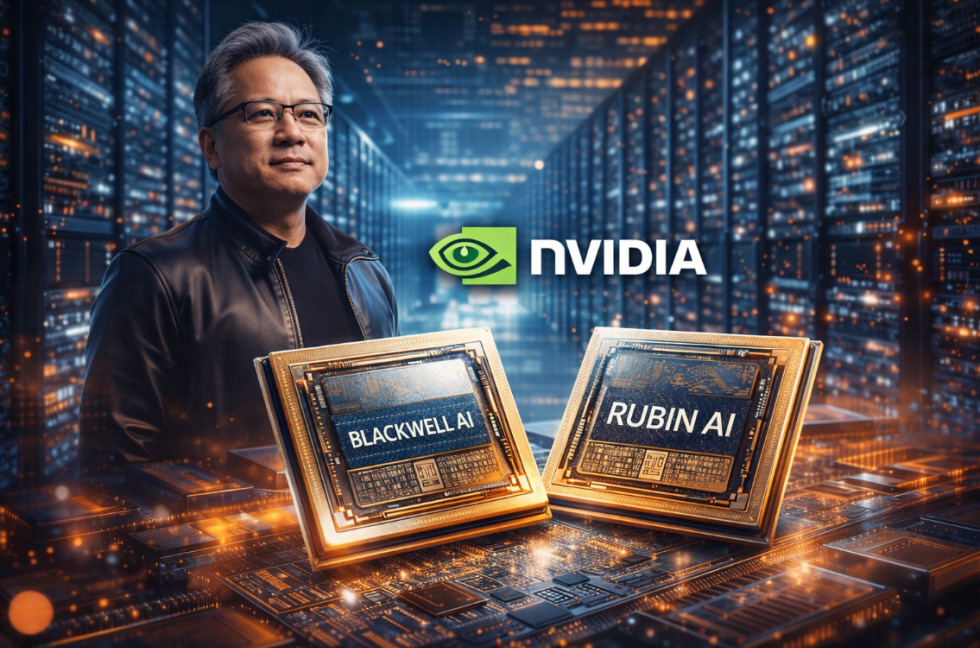
The CEO of Nvidia, Jensen Huang, has outlined an ambitious vision for the future of artificial intelligence, stating that two upcoming chip generations, Blackwell and Rubin, could generate more than $1 trillion in cumulative sales by the end of 2027. The projection reflects the rapidly growing global demand for advanced computing power. According to Huang, this estimate applies exclusively to AI processors, which are expected to drive the company’s growth in the coming years.
He made the remarks during a press conference in San Jose, emphasizing the central role these chips will play in next-generation technological platforms. The Blackwell and Rubin architectures represent Nvidia’s next leap in accelerated computing, delivering major improvements in performance, energy efficiency, and processing capabilities for increasingly complex AI models.
These innovations are designed to reinforce the company’s leadership in a highly competitive market. The projected revenue does not include other business segments such as networking chips or new processors based on external technologies, suggesting that the overall potential could be even higher when considering Nvidia’s broader ecosystem. In particular, the integration of technologies licensed from startups like Groq may further expand Nvidia’s capabilities and strengthen its market position.
Strategic collaborations allow the company to accelerate innovation and diversify its product offerings. The rise of artificial intelligence has triggered a global race to develop specialized hardware, with Nvidia emerging as one of the most influential players in the field. Its chips are widely used in data centers, scientific research, and large-scale commercial applications. Industry analysts believe Huang’s projection, while ambitious, aligns with strong growth trends in demand for AI infrastructure.
Companies worldwide are investing heavily in systems capable of supporting advanced models and massive data processing. Competition in this segment is also intensifying, with other tech giants developing their own solutions to capture market share. However, Nvidia maintains a significant advantage through its established ecosystem and continuous innovation.
The announcement reinforces the idea that artificial intelligence is not just a technological trend but a structural transformation of the digital economy. Specialized chips have become a strategic resource comparable to energy in previous eras. If these projections materialize, Nvidia could solidify a dominant position in the global tech industry, shaping the pace of innovation in artificial intelligence and redefining the future of large-scale data processing.