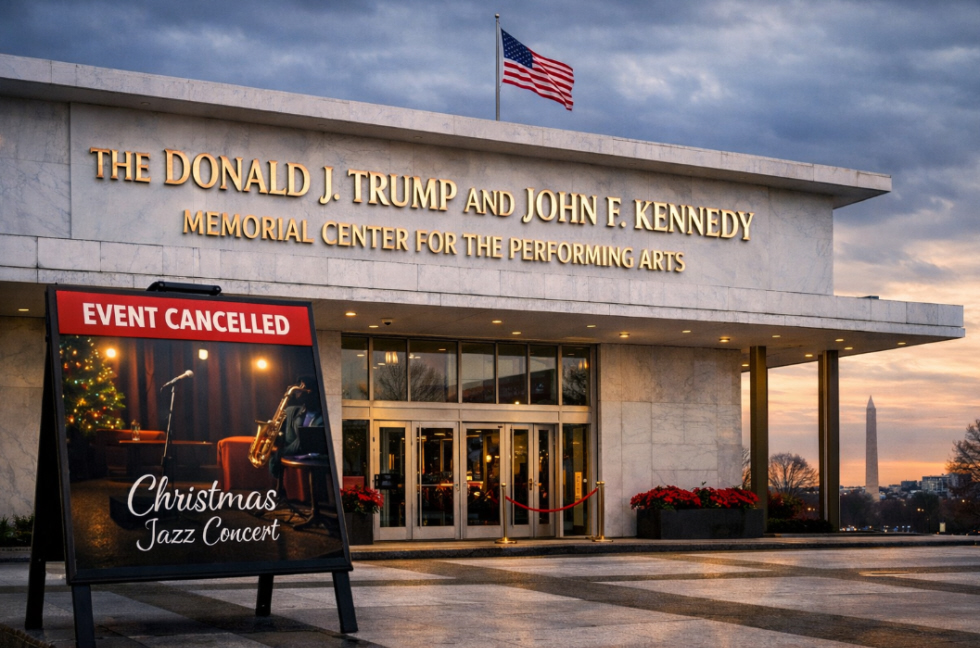
What was meant to be a festive Christmas Eve celebration ended in silence in Washington. The traditional holiday jazz concert at the Kennedy Center, scheduled for December 24 and held uninterrupted for more than two decades, was canceled at the last minute by its host, musician Chuck Redd. The decision was not driven by artistic or health concerns, but by an institutional change that sparked strong opposition: the addition of U.S. President Donald Trump’s name to the official designation of the building, now visible both on the façade and across the center’s official platforms.
The Kennedy Center was established in 1964 as a living memorial honoring President John F. Kennedy, and its symbolic identity has long been carefully preserved. The recent name change, pushed through by a reconfigured board following Trump’s return to power, has opened a legal and political debate over the limits of such authority. Legal experts and lawmakers argue that any alteration to the center’s name should require congressional approval, while members of the Kennedy family have publicly expressed their dissatisfaction with the move. For Chuck Redd, who has led the annual Christmas jazz concerts since 2006, the new name fundamentally altered the historical and cultural meaning of the venue.
He explained that the decision to cancel the concert was made when the new designation first appeared online and shortly afterward on the building itself. Seven musicians had been scheduled to perform that evening, in a concert that traditionally brought together local audiences and visitors during one of the most symbolic dates of the cultural calendar.
The cancellation is part of a broader climate of tension between the artistic community and the current administration. In recent months, several artists and producers have withdrawn or canceled scheduled appearances at the Kennedy Center, interpreting the institutional changes as a sign of growing politicization of culture. For some, these moves reflect a broader campaign against what is described as “woke” culture within publicly supported institutions.
Meanwhile, the Kennedy Center faces an uncertain path forward. It remains unclear whether ticket holders will receive refunds or whether the concert will be rescheduled at another time or venue. At the same time, legal challenges and public criticism continue to mount, questioning both the legality of the name change and its impact on an institution long regarded as a cultural space meant to stand above political disputes. The episode highlights how even long-standing artistic traditions can be disrupted amid deepening political polarization.