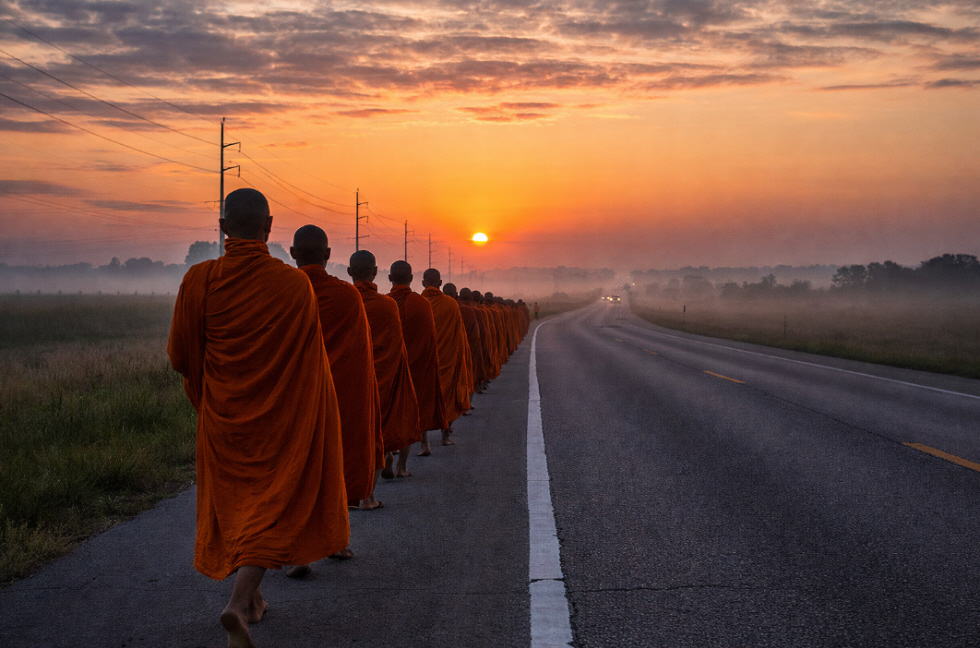
After more than three months walking across nine U.S. states, a group of Buddhist monks completed their “Walk for Peace,” a spiritual journey that began in Texas and concluded in the Washington, D.C., and Annapolis, Maryland area. Their goal was simple yet profound: to raise awareness about peace, compassion, and unity in a country experiencing visible political and social tensions.
From the beginning of the journey, the monks endured freezing temperatures, winter storms, and long daily stretches along highways and rural roads. Despite the physical hardship, their message remained consistent and non-confrontational. “We do not march to protest, but to awaken the peace that already lives within each of us,” one of the spiritual leaders said. The most difficult moment occurred in Texas, when an accident involved a support vehicle accompanying the group.
Several monks were injured, some seriously. One of them later underwent a leg amputation due to the severity of his injuries. The incident could have brought the pilgrimage to an immediate end. Instead, the group chose to continue. The decision was not framed as defiance, but as a reaffirmation of their commitment to the message they were carrying. For them, compassion and perseverance had to reflect the spiritual principles they practice. Along the route, local communities offered water, food, and words of encouragement. In several cities, small groups joined portions of the walk in symbolic solidarity, gradually transforming the march into a broader gesture of collective reflection.
In the nation’s capital, the monks were welcomed by citizens who viewed the initiative as a hopeful sign during a time of division. Some attendees described the walk as a reminder that dialogue and empathy remain possible even in polarized environments. The journey concluded in Annapolis with a symbolic gathering where local officials acknowledged the effort and the peaceful intent behind it.
Beyond formal recognition, the arrival marked the end of a demanding experience defined by sacrifice, faith, and determination. The march did not seek to propose political solutions or enter partisan debates. Its message was more direct and, in many ways, more challenging: cultivate peace from within. At a moment of visible division, the walk left behind an open question about the transformative power of compassion in society.