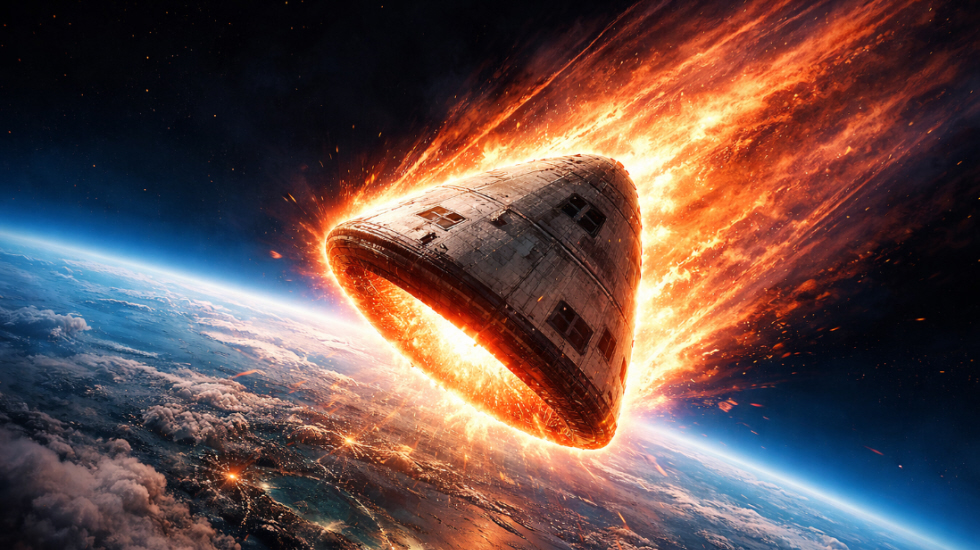
After traveling approximately 1.1 million kilometers in a historic journey around the Moon, the Artemis II crew entered the most critical phase of their mission: returning to Earth. After ten days in the silence of deep space, the goal was not just to come home, but to survive one of the most extreme tests in human exploration. The calm of the cosmos gave way to the roar of reentry. Inside the Orion capsule, Reid Wiseman, Victor Glover, Christina Koch, and Jeremy Hansen prepared to face the most dangerous stage of their journey.
It was not simply about returning, but doing so at speeds approaching 40,000 kilometers per hour. Every second mattered, and every system had to perform flawlessly. The reentry maneuver, one of the most complex operations in space engineering, demanded absolute precision. Before entering Earth’s atmosphere, the spacecraft executed critical trajectory adjustments. The separation of the European service module marked the point of no return, leaving the capsule alone against the forces ahead. As Orion entered the atmosphere, it transformed into a blazing fireball streaking across the sky at hypersonic speed.
The heat shield endured temperatures reaching nearly 2,800 degrees Celsius, while the outer layer burned intensely. Inside, however, advanced engineering kept the crew protected and stable. For several minutes, communication with mission control was lost, as expected. This blackout period represented one of the most tense moments of the entire mission. Without contact with Earth, the astronauts relied entirely on onboard systems and precise calculations. The crew described the experience as “riding inside a fireball,” capturing the intensity of the moment. Every vibration and pressure shift reminded them they were crossing the boundary between space and Earth.
Physics and engineering operated at their absolute limits. The return was also shaped by lessons learned from the past. During the uncrewed Artemis I mission, unexpected heat shield erosion raised concerns. Instead of replacing the system, engineers chose to adjust the reentry angle to improve safety and performance. This change in flight dynamics added a new level of complexity to the mission. The capsule had to strike a perfect balance between speed, resistance, and control.
A slight miscalculation could have led to catastrophic consequences. Finally, after surviving the most dangerous phase, the capsule deployed its parachutes and descended into the Pacific Ocean. The splashdown off the coast of San Diego marked the successful conclusion of a historic mission. What began as a technological challenge became a testament to human capability.
Artemis II represents more than a return to lunar orbit—it signals the beginning of a new era in space exploration. With each mission, humanity moves closer to establishing a sustained presence beyond Earth. This was not just a journey, but a declaration of the future.