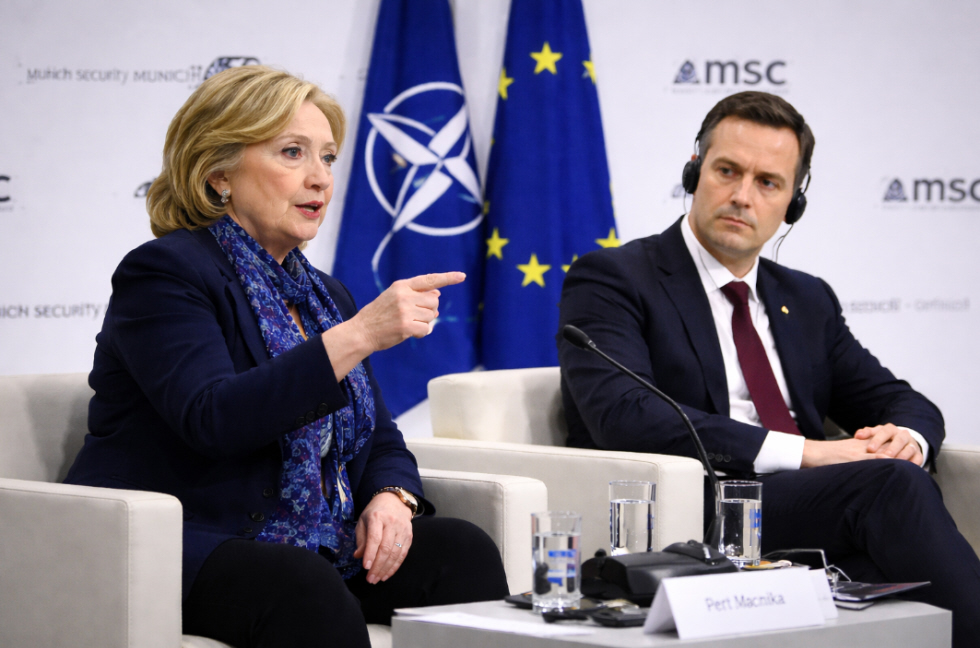
 he Munich Security Conference once again became a stage for political tension as former Secretary of State Hillary Clinton engaged in a pointed exchange with a Czech political leader during a panel discussion on the state of the West. The debate centered on the role of the United States in Europe and the broader direction of Western leadership.
Clinton voiced criticism of President Donald Trump’s approach toward European allies, questioning the diplomatic strategy adopted in recent years. During the discussion, Czech Deputy Prime Minister Petr Macinka defended the current U.S. administration, arguing that Washington’s policies reflect national security priorities and a reassessment of longstanding alliances.
The exchange revealed deeper differences over how transatlantic cooperation should evolve in a global landscape shaped by regional conflicts, economic pressures, and shifting geopolitical balances. Clinton emphasized the importance of maintaining strong alliances grounded in shared democratic values, while Macinka stressed the need to revisit agreements that, in his view, have not always delivered balanced outcomes for all parties involved.
The moment reflected more than a personal disagreement; it underscored broader divisions within the Western bloc regarding strategic priorities and power dynamics. The Munich Security Conference has long served as a barometer of international relations, and this episode highlighted ongoing debates about the future of Western unity. Beyond the immediate exchange, the underlying issue concerns how the United States and Europe define their partnership amid rising global competition and security challenges.
Observers note that such public disagreements illustrate the evolving nature of political discourse within democratic societies, where differing perspectives on security and cooperation are increasingly visible. As the international environment grows more complex, the discussions in Munich suggest that Western leadership is undergoing a period of reassessment, marked by open debate and strategic recalibration.