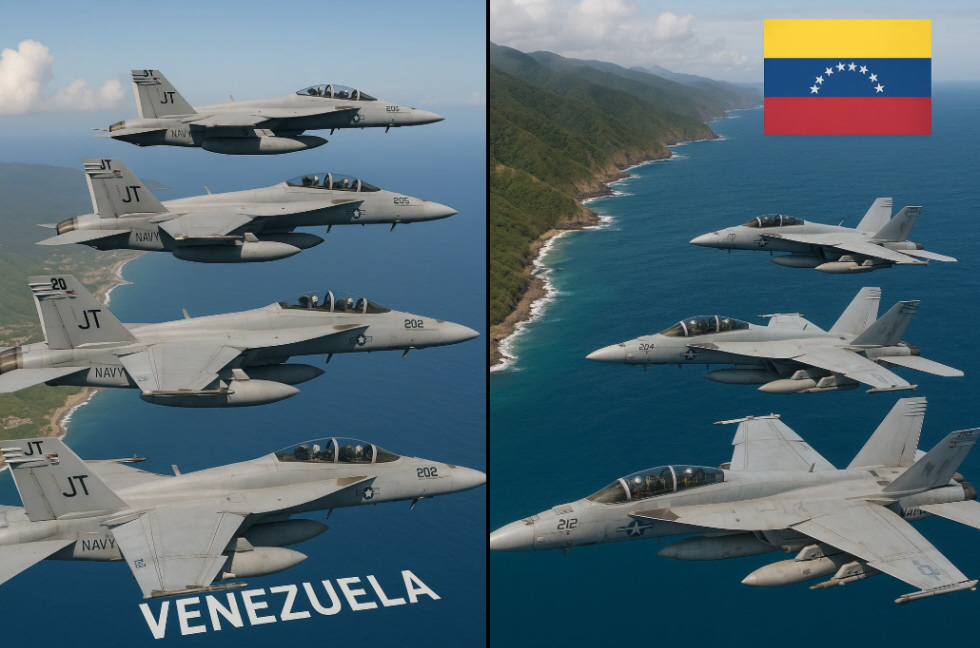
The war of words between the United States and Venezuela intensified on Friday when U.S. President Donald Trump warned that any Venezuelan military aircraft that endangered an American vessel “will be shot down.” His remarks, delivered at the White House, followed an incident earlier in the week in which U.S. forces fired on a ship from Venezuela allegedly carrying narcotics, leaving eleven crew members dead.
The Maduro government immediately condemned the operation, calling it “extrajudicial executions” and accusing Washington of illegally resorting to force. Trump has made the fight against Latin American drug trafficking one of the cornerstones of his foreign policy, insisting that Venezuela under Nicolás Maduro has turned into a “narco-state” that protects and directs criminal networks.
The White House maintains that Maduro is linked to drug cartels and accuses groups such as the Tren de Aragua, founded in Venezuela, of functioning as outright terrorist organizations. Since Trump took office in January, the U.S. has added the group and others to its list of international terrorist entities, significantly increasing political and diplomatic pressure on Caracas. Tensions, however, go beyond drug trafficking.
Washington also expressed alarm at threats from Maduro’s government to “invade” Puerto Rico, a U.S. territory without statehood. In response, Trump ordered the deployment of ten F-35 fighter jets to the island, both to send a message of strength and to guarantee its defense. Puerto Rico’s governor, Jenniffer González-Colón, had already requested military assistance back in January, warning that Maduro’s threats posed a direct challenge to the sovereignty and security of the region.
In a public letter, she urged the president to send a clear message against what she described as “murderous dictators.” For his part, Venezuelan President Nicolás Maduro has escalated his rhetoric, accusing the United States of being “the greatest threat to Latin America in the past one hundred years.” Maduro stressed that any military aggression against Venezuela would trigger an immediate armed response.
According to official figures, Caracas has mobilized 340,000 active soldiers and millions of reservists, which Maduro frames as a strategy of national defense against potential foreign attack.
The international community is watching the escalation with deep concern. Analysts warn that the clash of narratives—Trump portraying Venezuela as a hub of drug trafficking and Maduro accusing Washington of imperialism—risks escalating into direct confrontation, with serious repercussions for regional stability.
At the same time, multilateral organizations and allied governments are attempting to cool the heated rhetoric and open diplomatic channels in hopes of preventing the crisis from spiraling into open conflict.