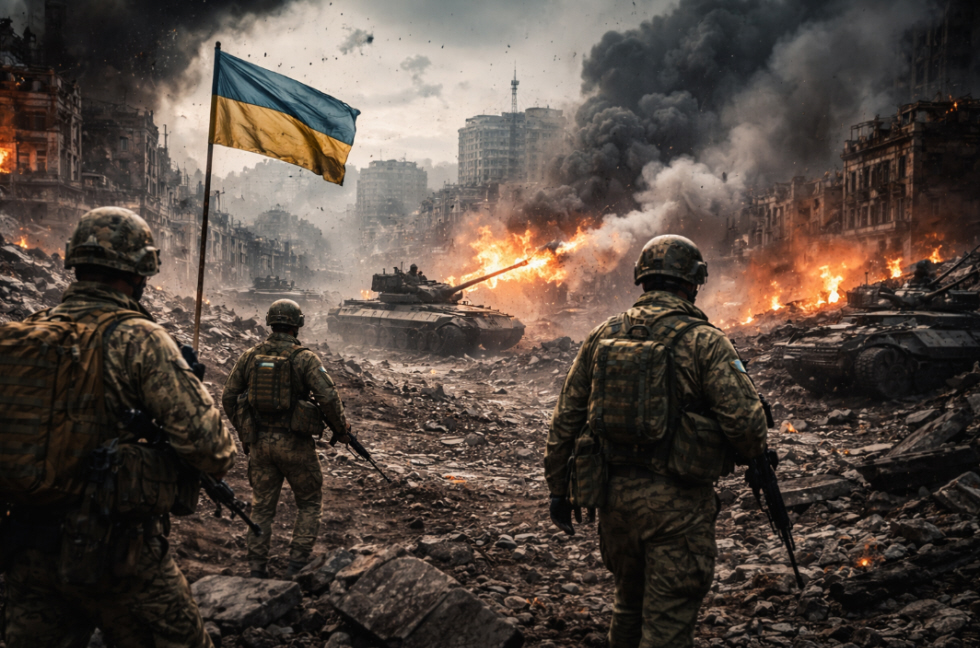
This year marks the fourth anniversary of Russia’s invasion of Ukraine, a conflict that profoundly reshaped Europe’s security architecture and redefined the global geopolitical balance. What the Kremlin initially described as a “special military operation” quickly evolved into the most serious war on European soil in decades. The launch of the offensive became a historic turning point.
Missiles striking Ukrainian cities, military columns advancing toward strategic territories, and millions of civilians forced to flee created a scenario that shocked the international community and revived tensions reminiscent of the Cold War era. Four years later, the human cost remains one of the most painful dimensions of the conflict. Thousands of lives have been lost, families remain separated, and entire communities continue rebuilding amid uncertainty, with no definitive resolution in sight. On this anniversary, the Ukrainian president has once again called for a just and sustainable peace.
For Kyiv, any agreement must guarantee full sovereignty, territorial integrity, and credible security assurances to prevent future aggression. It is not only about ending the fighting, but about securing long-term stability. From Moscow, however, the narrative has remained consistent. The Kremlin continues to frame the war as a “special operation” and maintains that its strategic objectives are still in place, arguing that any negotiation must acknowledge what it considers new realities on the ground.
The impact of the conflict has extended far beyond the battlefield. Europe accelerated its energy restructuring, NATO expanded with new members, and global markets faced pressure in commodities, food supplies, and fuel prices. The war ceased to be a regional issue and became a structural factor in the global order. On the military front, the war has produced significant attrition on both sides. Front lines have shifted over time, but the prolonged confrontation has demonstrated that neither side has secured a decisive victory, prolonging strategic uncertainty.
Throughout these four years, various diplomatic efforts have emerged without producing a lasting agreement. Mutual distrust, territorial demands, and the need for credible security guarantees continue to stand as major obstacles at the negotiating table. New peace talks could resume this week. While expectations remain cautious, the continuation of dialogue suggests that both sides recognize the necessity of exploring diplomatic pathways, even amid profound disagreements.
At its fourth anniversary, the war in Ukraine represents more than a territorial dispute. It has become a broader struggle over sovereignty, influence, and the balance of power in Europe. The direction taken by negotiations in the coming days could significantly shape regional stability and the international order for years to come.