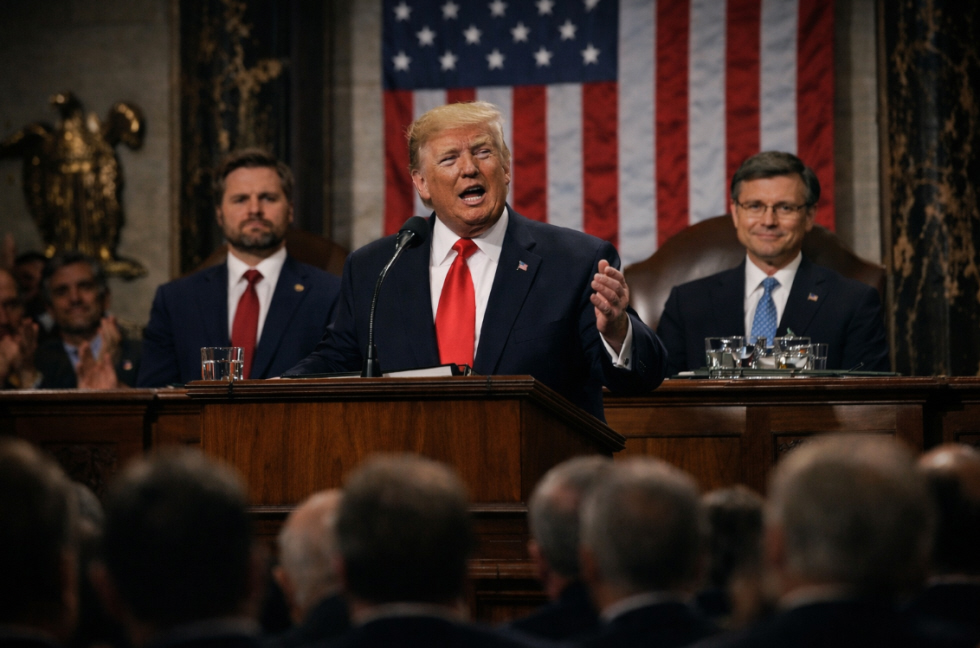
President Donald Trump delivered his State of the Union address before Congress in an atmosphere marked by political polarization and national anticipation. From the outset, he made it clear that his message would focus on defending his administration’s record and projecting an image of economic strength and firm leadership both domestically and abroad. The address was lengthy and carefully structured.
Trump relied on a teleprompter to maintain rhythm and organization, although at times he shifted into a more spontaneous tone, especially when responding to applause or reactions from members of his party. One of the central pillars of the speech was the economy. The president stated that the country is experiencing a period of recovery and growth, highlighting employment figures, domestic production, and financial stability. He presented these indicators as proof that his policies are delivering tangible results.
Regarding inflation and rising costs, he argued that economic pressures are being contained and that his administration is committed to strengthening American industry. He reiterated his approach of protecting domestic production and encouraging job creation through incentives and trade measures. Immigration occupied a significant portion of his remarks. Trump emphasized that border security remains an absolute priority and defended stricter measures to curb irregular migration.
This segment drew strong applause from Republican lawmakers and visible disagreement from Democrats. In foreign policy, the president adopted a firm tone. He spoke about the United States’ position in global conflicts and described what he called strategic progress in defending national interests. His message aimed to project determination and leadership on the international stage. He also addressed domestic security and the strengthening of law enforcement institutions. He underscored the importance of maintaining public order and increasing resources to combat crime, arguing that social stability is essential for economic progress.
Throughout the speech, the president invited and recognized several guests in attendance, including members of the armed forces and individuals distinguished in various fields. These moments were designed to humanize the address and connect his message to personal stories of resilience and sacrifice. The overall tone became combative in certain passages, particularly when referring to political opponents. He criticized past decisions and challenged positions that, in his view, weakened the country’s standing in previous years. This dynamic highlighted the deep divisions that continue to define the current political landscape.
Despite consistent applause from his party, the atmosphere in the chamber revealed clear contrasts. Some lawmakers remained silent during key segments, reflecting the ideological differences shaping the national debate. The closing message sought to convey optimism. Trump appealed to patriotism and the idea that the United States is at a decisive moment, insisting that the nation has the capacity to overcome internal and external challenges if it maintains strong direction.
Overall, the address reaffirmed the president’s political priorities: a combination of economic nationalism, strict immigration control, security emphasis, and assertive international leadership. Beyond the applause and criticism, the speech underscored that the debate over the country’s direction will remain intense in the months ahead.