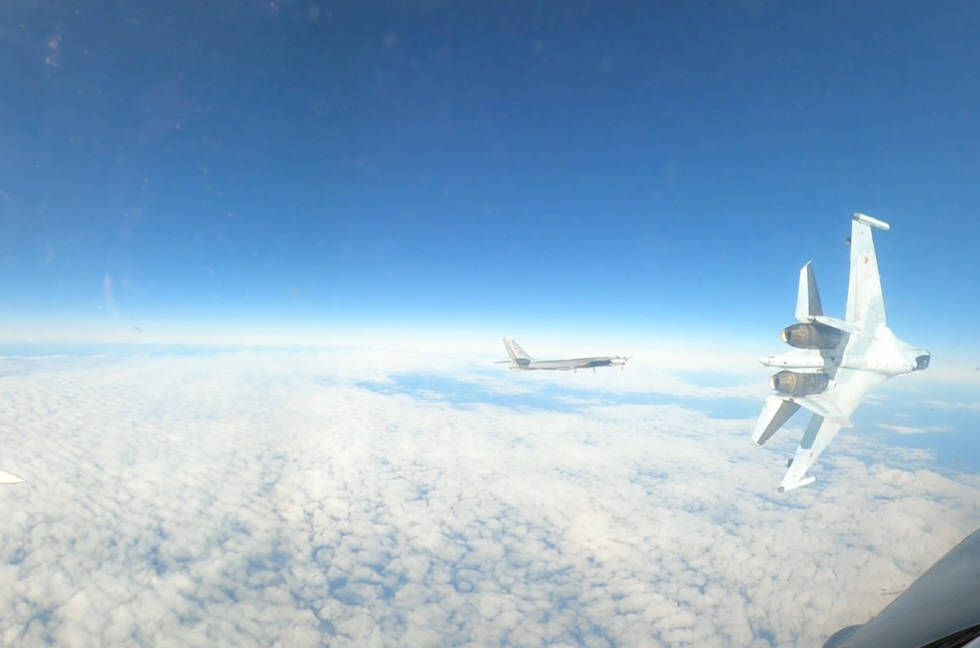
Military tension between Russia and the West escalated once again with a new aerial incident off the coast of Alaska. On Wednesday, American and Canadian fighter jets scrambled to intercept four Russian aircraft that had entered the Air Defense Identification Zone (ADIZ), an international space monitored by the United States and Canada for security purposes.
According to official reports, the Russian formation consisted of two long-range strategic Tu-95 bombers escorted by two modern Su-35 fighters, whose presence triggered an immediate defensive response. The North American Aerospace Defense Command (NORAD) confirmed the operation and reported that it deployed an E-3 early warning aircraft, four F-16 fighters, and four KC-135 tankers to ensure the positive identification and escort of the Russian planes. While authorities emphasized that the flights did not represent a violation of U.S. or Canadian sovereign airspace, the frequency of such incidents has raised alarms in Washington and among its allies.
Military experts believe these maneuvers are part of a pattern of provocations aimed at testing NATO’s response capabilities during a period of global political tensions. This episode adds to a chain of recent confrontations. In Europe, Denmark is still investigating the appearance of large unidentified drones that massively disrupted operations at Copenhagen Airport, while in September Polish and NATO aircraft shot down Russian drones that had crossed into Polish airspace.
Estonia also reported violations of its airspace by Russian military aircraft, reinforcing the perception that Moscow is seeking to send strong signals both in the Arctic and across Europe. It is not the first time Alaska has become the stage for such tensions. Just a month ago, a Russian reconnaissance plane was detected several times in the same zone, and in September 2024 NORAD released a dramatic video showing a Russian aircraft dangerously approaching a U.S. plane, a maneuver described as unsafe and unprofessional.
These incidents underscore the idea that the ADIZ, while international, has effectively become a testing ground between rival powers. NATO Secretary General Mark Rutte this week backed the message of U.S. President Donald Trump, who warned that he would not hesitate to order the downing of Russian aircraft if they cross into allied airspace. “If necessary, I completely agree with President Trump on this,” Rutte told Fox News.
The statement, however, has sparked debate within the Alliance about the limits of such retaliation and the risks of escalating into a broader conflict. For now, the Russian aircraft stayed out of U.S. and Canadian sovereign territory, but they tested defenses and heightened pressure in an already fragile scenario. Every flight, every maneuver, and every interception serves as a reminder that the aerial balance in the Northern Hemisphere grows increasingly unstable—and that a single miscalculation could have unpredictable consequences.