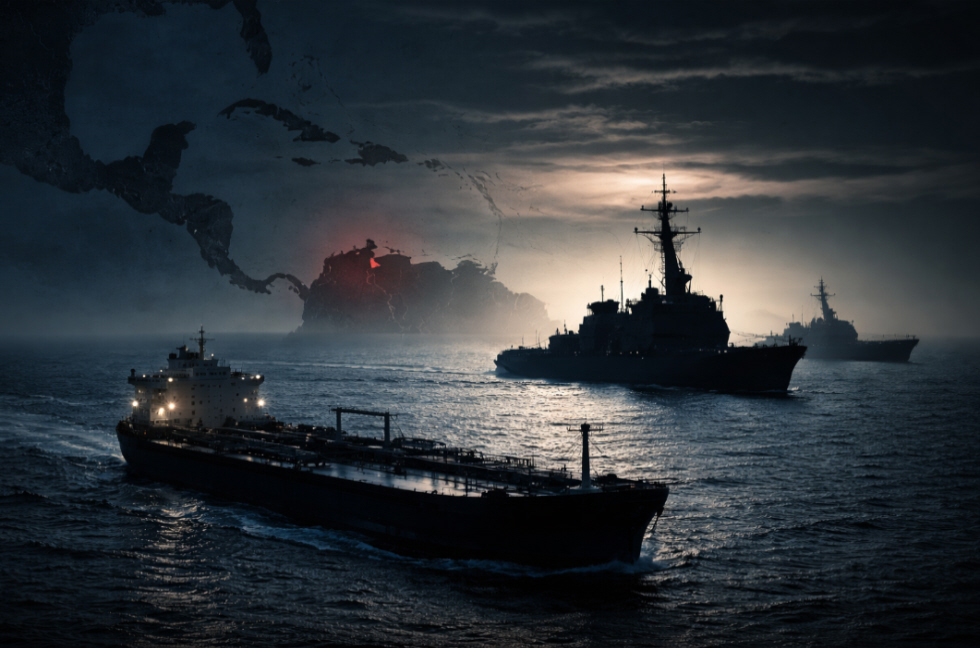
The United States has taken a dramatic and dangerous step in its confrontation with Venezuela. President Donald Trump announced a “total and complete blockade” against oil tankers linked to U.S. sanctions, effectively attempting to choke all maritime traffic entering or leaving the country. The decision is paired with an even more provocative move: the classification of the Venezuelan state as a “foreign terrorist organization,” while Washington publicly celebrates the deployment of naval forces surrounding the nation. A blockade is not a surgical measure. It is a blunt instrument of collective punishment.
It does not discriminate between government officials and ordinary citizens, between political leaders and working families. For a country whose economy depends heavily on oil exports—not only to sustain its own population but also to support regional partners such as Cuba—cutting maritime lifelines directly threatens access to food, medicine, fuel, and basic services. The consequences are not abstract. They are human, immediate, and regional. This strategy is not new. In 2019, as U.S. sanctions intensified, then–Secretary of State Mike Pompeo openly acknowledged that the pressure campaign was worsening the humanitarian crisis “by the hour.”
The admission revealed the underlying logic of the policy: suffering was not an unintended side effect, but a calculated lever to force political change. Civilian pain became a tool of statecraft. What is unfolding now is an escalation of that same doctrine, repackaged with greater force and fewer restraints. Critics have described it as a modern extension of hemispheric dominance thinking—a belief that Washington reserves the right to override international law, sovereignty, and fundamental human rights in pursuit of its strategic objectives.
By turning economic warfare into open maritime coercion, the United States risks normalizing measures that destabilize not only Venezuela, but the broader Caribbean and Latin American region. History shows that blockades rarely produce democratic renewal or political reconciliation. More often, they entrench hardship, deepen polarization, and leave lasting scars on societies already under strain. The current course signals not diplomacy, but confrontation—one whose costs will be paid far beyond presidential statements or naval deployments, by millions of lives caught in the middle.