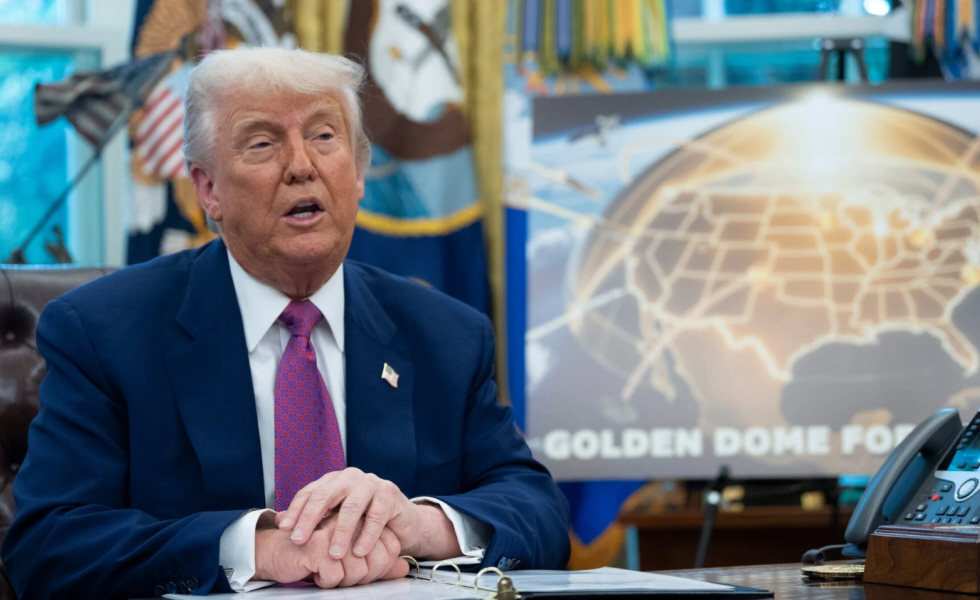
The “Golden Dome” missile defense system, spearheaded by Donald Trump’s administration, has unveiled new details showing a four-layer defense architecture designed to protect the U.S. mainland, Hawaii, and Alaska. One layer will be space-based, using satellites capable of detecting and intercepting missiles, while the remaining three layers will be ground-based and include interceptors, advanced radar systems, and possibly laser technologies.
Presented under the slogan “Go Fast, Think Big!”, the project was introduced to around 3,000 defense contractors in Huntsville, Alabama, along with plans for a new missile field in the Midwest to complement existing installations in California and Alaska. The current estimated cost is approximately $175 billion, although there is still uncertainty about the exact number of interceptors, launch sites, and other required infrastructure.
Congress has already allocated $25 billion, and the 2026 budget proposal includes an additional $45.3 billion. The U.S. defense industry is actively mobilizing to secure a place in the program, although many key details remain classified and discussed behind closed doors.
At the same time, the initiative has sparked international criticism: Russia, China, and North Korea have all questioned its strategic implications. Russia warned that it destabilizes the global balance, China accused the project of militarizing space in violation of international treaties, and North Korea described it as a provocative “nuclear war scenario.” Military experts note that although inspired by Israel’s “Iron Dome” system, the continental and space-based scale of the “Golden Dome” presents unprecedented technical and financial challenges.