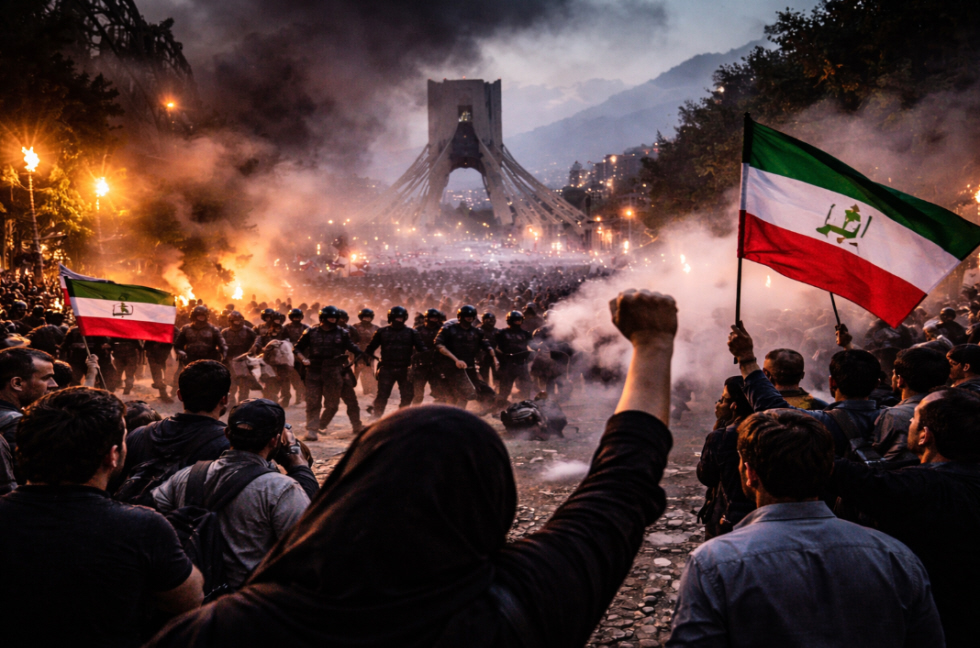
The growing repression of protests in Iran has once again placed the country at the center of international attention. Demonstrations that have spread across several cities in recent days have prompted an increasingly forceful response from Iranian authorities, while warnings and calls for restraint continue to emerge from abroad. In this context, U.S. President Donald Trump has publicly warned that his administration is considering possible forms of intervention if abuses against protesters persist. His recent remarks have been widely interpreted as political pressure rather than an immediate announcement of military action.
The response from Tehran was swift. Iranian Parliament Speaker Mohammad Bagher Ghalibaf stated in a televised address that any U.S. attack would carry direct consequences. According to his comments, Iranian forces would consider U.S. military interests and allied territories in the region as legitimate targets. These statements have raised concern in Israel, a country frequently referenced indirectly by Iranian officials. Sources close to the Israeli government indicated that the country has been placed on high alert, although specific measures and their scope have not been publicly detailed. Meanwhile, protests inside Iran continue.
Over the weekend, residents in several areas of Tehran returned to the streets, using symbolic acts such as banging pots and chanting slogans critical of the current leadership. Some of these messages reflect discontent that goes beyond economic grievances and points directly to the existing political system. Iranian authorities, for their part, maintain that the protests are being encouraged from abroad. Officials have repeatedly accused the United States and Israel of inciting unrest, an argument used to justify tighter security measures and internal controls. One of the most concerning developments has been the prolonged shutdown of internet access.
For more than 60 hours, large parts of the country have remained offline, making it difficult to independently assess the scale of clashes and the response by security forces. Monitoring organizations have noted that such blackouts severely limit the flow of information. The protests, which initially emerged in response to rising living costs and inflation, have quickly taken on a political dimension. An increasing number of demonstrators are calling for structural changes and an end to clerical rule, further heightening tensions between the public and state institutions.
In response, Iran’s Revolutionary Guard has reiterated that maintaining security represents a “red line.” This warning suggests that authorities are unwilling to tolerate further escalation, even amid international pressure and statements from Washington. For now, the situation remains fluid and highly uncertain. Amid escalating rhetoric, ongoing protests, and growing regional tension, the international community continues to watch closely, aware that any miscalculation could have consequences extending far beyond Iran’s borders.
🎧 U.S.–Iran Tensions Rise Amid Warnings And Protests
A concise update on escalating rhetoric and a volatile regional climate.
“When warnings harden on both sides, the space for de-escalation narrows.”