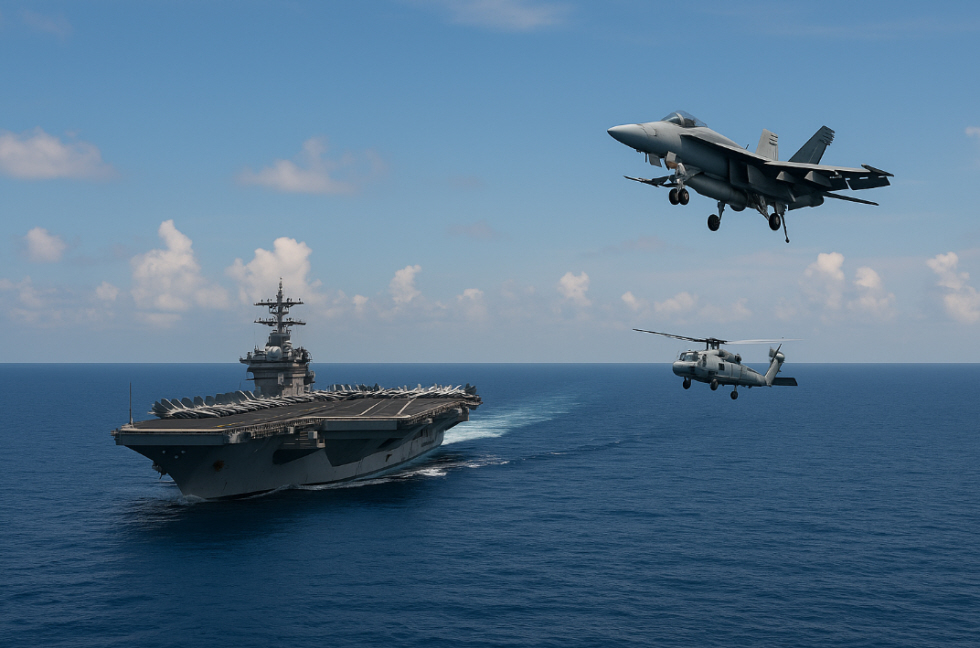
What was meant to be a routine flight turned into a double accident over the South China Sea. A U.S. fighter jet launched from an aircraft carrier and a military helicopter conducting support maneuvers both went down on Sunday for reasons that remain under investigation. According to early reports, the events occurred within minutes of each other: first, the fixed-wing aircraft declared an emergency, and during the ensuing response operations, the helicopter suffered a malfunction that forced it to make a controlled water landing.
Search-and-rescue teams from the carrier group and escort vessels recovered all crew members, who were taken on board for medical evaluation. Initial assessments indicate minor injuries and moderate hypothermia due to exposure to seawater. The incident took place in one of the world’s most heavily trafficked and politically sensitive maritime regions, where the United States and its allies maintain a regular presence for training and patrol missions in international waters.
Weather conditions were reported as unstable, with strong gusts of wind and higher-than-usual waves complicating the delicate process of takeoffs and recoveries at sea. Still, Navy officials emphasized that there is no evidence of a mid-air collision or external hostile action. Analysts suggest that a combination of factors —ranging from undetected mechanical issues to procedural errors under operational stress— may explain how two aircraft could be lost in such a short time frame, especially during exercises that demand tight coordination between flight decks, air traffic control, and aircraft in patrol formation.
The U.S. Department of Defense has launched a full technical investigation. As part of standard protocol, flight data recorders, maintenance logs, cockpit recordings, and communication records with the carrier’s flight control will be collected and analyzed. Procedures related to catapult launches, nighttime approaches, and search-and-rescue coordination will also undergo review. Until the inquiry concludes, the aircraft carrier has temporarily suspended flight operations to conduct additional safety inspections on catapults, arresting cables, and other critical systems of the embarked air wing.
Meanwhile, logistical chains are assessing spare-part inventories and updating simulator programs to integrate preliminary lessons learned. Although all crew members were safely recovered, the incident serves as a reminder of the inherent risks of naval aviation in a region where every maneuver is closely watched and carries geopolitical weight far beyond the flight deck.