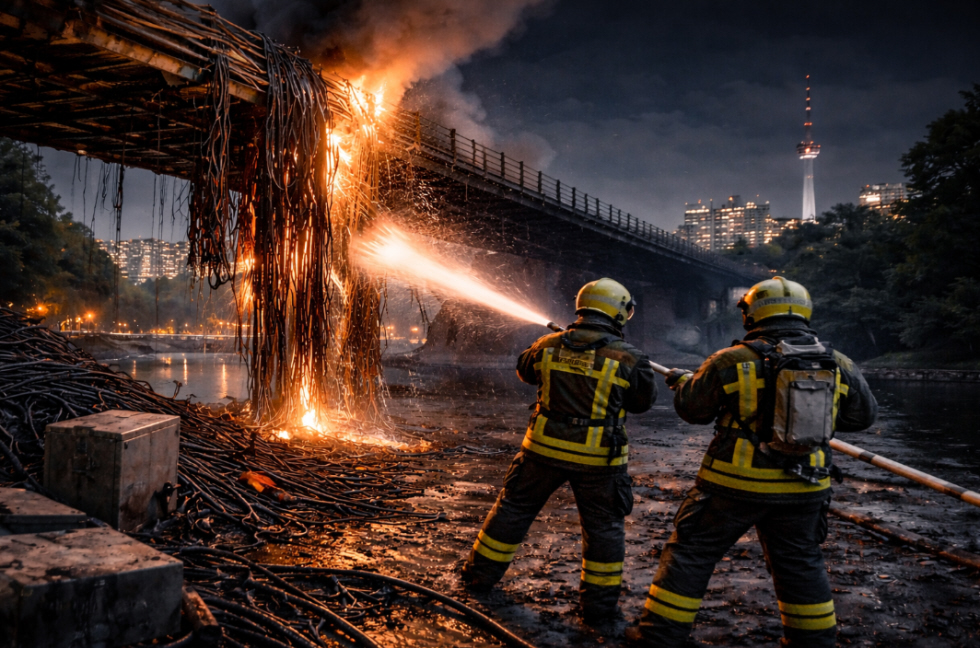
A suspected arson attack on critical electrical infrastructure has left tens of thousands of people without power in southwest Berlin, in one of the most serious incidents affecting the city’s energy network in recent times. According to authorities, the power outage currently affects around 26,900 households, as well as 1,220 commercial businesses, causing significant disruptions to daily life and economic activity in the affected areas. The blackout occurred after a deliberate fire was set on a cable bridge located along the Teltow Canal, a piece of critical infrastructure through which essential power connections run.
The damage forced the network operator to shut down the supply immediately for safety reasons. Preliminary investigations suggest that the attack may have been carried out by left-wing extremists. In this context, police consider a claim-of-responsibility letter from a group calling itself Vulkangruppe to be credible, reinforcing the theory of ideologically motivated sabotage. The case is currently being investigated by the Berlin Attorney General’s Office, while authorities assess whether the Federal Prosecutor’s Office in Karlsruhe will assume jurisdiction, given the potential terrorist nature and broader national impact of the attack.
The electricity network operator, Stromnetz Berlin, stated that repair work is progressing continuously and expects to fully restore power supply by Thursday afternoon, although it warned that the complexity of the damage could lead to minor delays. The incident has reignited debate over the security of critical infrastructure in Germany. In response to the attack, the Federation of German Industries (BDI) expressed concern over the vulnerability of key sectors such as energy, logistics, and communications.
Holger Lösch, deputy director general of the BDI, warned that so-called hybrid threats—which combine physical sabotage with ideological and strategic objectives—have been a reality for some time and represent a direct attack on the backbone of the economy and the state’s ability to act effectively. Industry representatives criticized the fact that, despite multiple recent incidents across Europe, the urgency of the problem continues to be underestimated at the political level, leaving essential infrastructure exposed to similar attacks.
Against this backdrop, the German government is working on legislation aimed at strengthening the protection of critical infrastructure, known as Kritis, by establishing mandatory security requirements and improving safeguards against acts of sabotage. The Berlin blackout not only highlights the vulnerability of certain strategic points within the power grid but also raises broader questions about the state’s capacity to respond to targeted attacks designed to disrupt essential services. As investigations and repair efforts continue, the case is emerging as a key reference point in the debate over security, extremism, and infrastructure protection in Germany and across Europe.