Recent threats by U.S. President Donald Trump regarding Greenland are acting as a political wake-up call across Europe. What for years was dismissed in some capitals as rhetorical provocation is now increasingly viewed as a strategic turning point that forces a reassessment of the transatlantic relationship. European governments privately acknowledge that the long-standing approach of “wait and see” toward Washington is no longer viable.
Senior officials admit that a coordinated transition toward a new reality is needed, one in which Europe assumes greater responsibility for its own security, foreign policy, and strategic autonomy. This reassessment goes beyond trade or diplomacy. The main focus is the continent’s security architecture, which has historically relied on the United States. Trump’s statements, combined with threats to impose punitive tariffs on allies opposing his stance on Greenland — a territory belonging to Denmark — have been interpreted as direct political pressure on European partners.
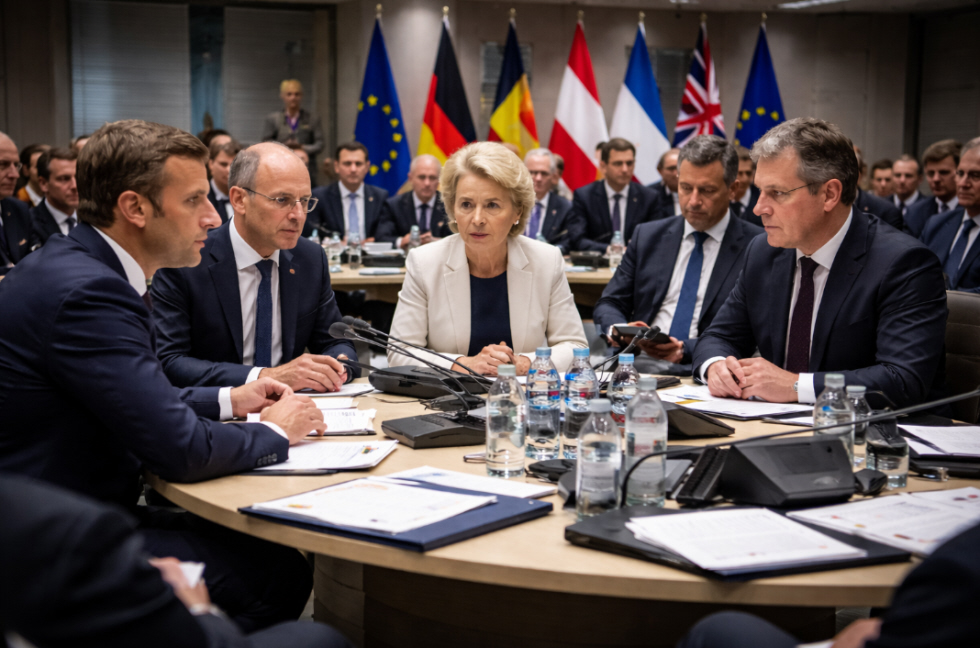
In this context, attention has turned to a cooperative structure that already operates without U.S. involvement: the so-called “coalition of the willing” supporting Ukraine. National security advisers from around 35 countries, including EU members as well as the United Kingdom and Norway, maintain close and ongoing coordination outside traditional frameworks. Cooperation has also intensified at the highest political level. Leaders such as Emmanuel Macron, Keir Starmer, Friedrich Merz, and European Commission President Ursula von der Leyen engage in regular informal exchanges, reflecting Europe’s search for unity amid a more uncertain global environment.
In internal discussions, European officials describe the U.S. pressure as an unprecedented political challenge among allies. For the first time in decades, a prolonged rupture with Washington is being seriously considered, driven by a growing conviction that Trump’s course is not a temporary phenomenon. At the same time, NATO’s role is undergoing renewed scrutiny.
In Brussels, initiatives are multiplying to make Europe capable of defending itself independently by 2030, with proposals ranging from a permanent EU intervention force to new coordination formats involving non-EU partners such as the United Kingdom. While no one is openly calling for the abandonment of the Atlantic Alliance, the debate over a more independent European security order is no longer theoretical. The Greenland dispute has accelerated a reflection that could reshape Europe’s strategic balance and mark the beginning of an era in which U.S. support is no longer taken for granted.