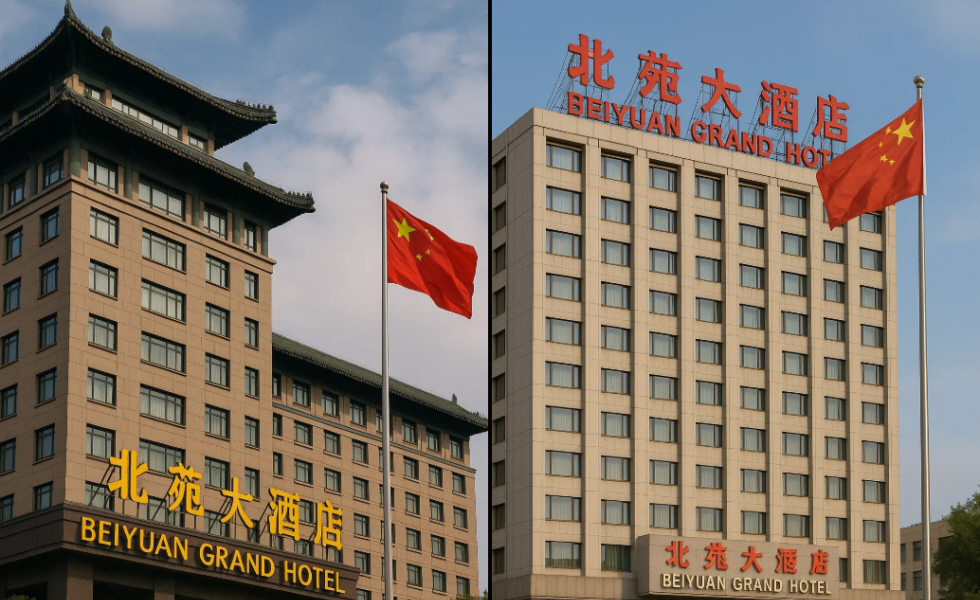
The world’s second-largest economy is increasingly under deflationary pressure: prices are falling across many industries, including the hotel sector. Now, creative ideas are needed. “These days, people don’t just come because you lower prices or offer discounts — they simply don’t come at all,” complains Anwen Xu, sales director of the Beiyuan Grand Hotel in Beijing. The hotel industry is suffering from weaker consumer demand, but also from cuts to corporate and government travel budgets, as well as a lack of banquet bookings. Significant risk of deflation This is due in no small part to a political measure: the government has tightened austerity rules for public sector employees and party members, including banning large group dining and restricting alcohol consumption. Analysts see the problems in the hotel industry as a warning sign. “These luxury food service establishments, especially five-star hotels, need to make strategic adjustments to survive,” says He-Ling Shi, professor of economics at Monash University in Melbourne. “This phenomenon reflects that the macroeconomic situation in China now faces a fairly significant risk of deflation.” Breakfast for 40 cents: profits vanish Other signs of deflation — a broad-based decline in prices — can be seen in breakfast deals for three yuan (just under 40 cents) or aggressive discount campaigns in supermarkets.
This inevitably impacts corporate balance sheets: according to official figures, profits in the accommodation industry in the capital, Beijing, plunged 92.9 percent in the first half of 2025 compared with the same period last year. Companies are also finding it difficult to push through higher prices across the wider economy: the inflation rate was zero percent in July. What at first glance may seem like a gift for consumers has negative consequences for the economy upon closer inspection. Without higher prices, many companies lack the funds for new hiring and investment.
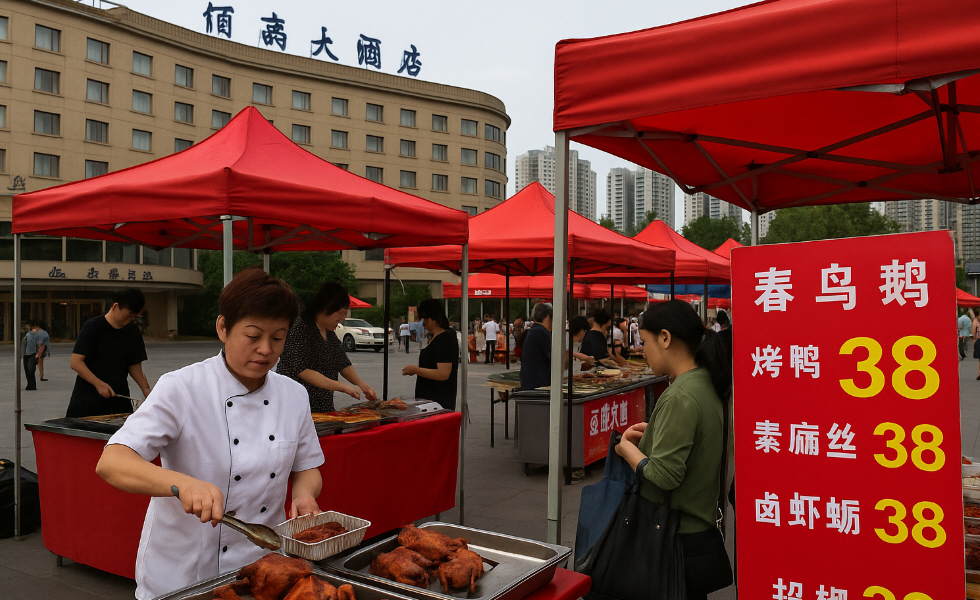
Consumers are hunting for bargains, says Yaling Jiang, founder of the consultancy ApertureChina. However, they are “reluctant” to spend in the high-price segment. This is confirmed by customer Seven Chen, who buys grilled meat in front of the Beiyuan Hotel. “The main reason is that people don’t have enough income,” explained the resident, who works in the financial sector. He himself also spends less time in expensive hotels than before.
Street vending as a source of income Street sales have become an important alternative source of revenue for many hotels. The Grand Metropark Hotel in Beijing says it makes a few thousand extra yuan a day selling braised duck or crayfish. At the Beiyuan, the top seller is crispy roasted pigeon at 38 yuan — compared with 58 yuan in the restaurant. Since street sales began in late July, about 130 pigeons have been sold each day, up from about 80 before.
Street vending works with a profit margin of 10 to 15 percent, Xu explains. This is better than with average catering service. However, it is still not enough to fully offset the drop in house revenues. Shen Qiuya rejects the idea that street sales could harm brand value. She is the marketing and sales manager at the five-star River & Holiday Hotel in Chongqing. Her property has increased daily sales from a few thousand to 60,000 yuan after setting up stalls in its parking lot last month. “All industries are having difficulties this year,” she says. “Survival is the most important thing. Saving face means nothing.”