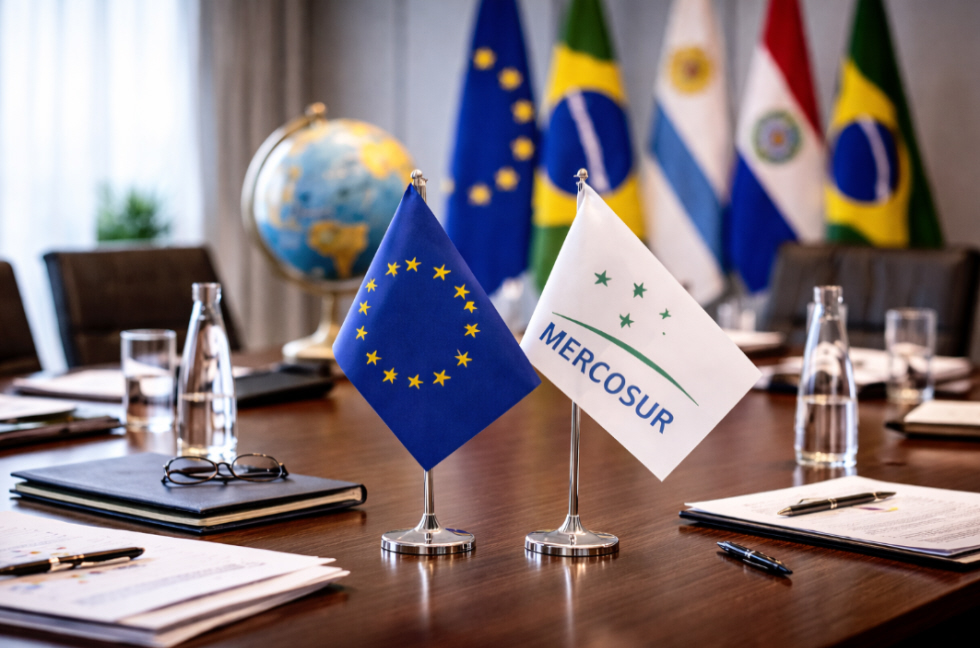
The European Commission is aiming to conclude the long-negotiated and controversial free trade agreement between the European Union and Mercosur before the end of the year, with a formal signing currently scheduled to take place in Paraguay on January 12, 2026, according to the timeline being discussed by the parties. However, deep divisions among EU member states continue to complicate the approval process.
Against this backdrop, Brazil has stepped up political pressure and warned that it could withdraw its support if the agreement is not approved within the expected timeframe. Brazilian President Luiz Inácio Lula da Silva issued a strong warning, stating that if the deal — negotiated since 1999 — is not finalized in time by the European Union, Brazil will no longer back it for as long as he remains in office. Lula stressed that his country has waited 26 years for the agreement and said that Mercosur member states — Argentina, Bolivia, Brazil, Paraguay, and Uruguay — have accepted everything that was “diplomatically possible” to facilitate an understanding with Europe.
Resistance within the EU remains particularly strong in countries such as Italy, France, Austria, and Poland, where concerns persist over the potential impact of the agreement on domestic agriculture. Italian Prime Minister Giorgia Meloni has reiterated her opposition to a rapid conclusion of the deal, arguing that it should only be signed once it is clearly beneficial to all sectors and once adequate safeguards for European farmers are in place. She has also emphasized the need for solid guarantees of reciprocity in agricultural trade and described any premature signing as inappropriate before a protective measures package is finalized with the European Commission.
In contrast, Germany continues to push for a swift conclusion. Berlin views the agreement as a strategic priority and is pressing for a political consensus before the end of the year to allow the planned signing in January 2026. German Chancellor Friedrich Merz is continuing efforts to persuade skeptical partners, arguing that the deal would not only deliver significant economic benefits but also demonstrate the European Union’s capacity to act decisively in an increasingly competitive and fragmented global trade environment.
The issue is expected to reach a decisive phase in the coming weeks, with several high-level meetings scheduled in Brussels and other European capitals. Should the necessary political consensus be achieved, the signing of the agreement in Paraguay on January 12, 2026 would bring to a close one of the longest and most complex trade negotiations in recent history.
If implemented, the EU-Mercosur agreement would create the world’s largest free trade area, encompassing more than 720 million people, accounting for nearly 20 percent of the global economy and over 31 percent of worldwide goods exports, underscoring its far-reaching economic and geopolitical significance.