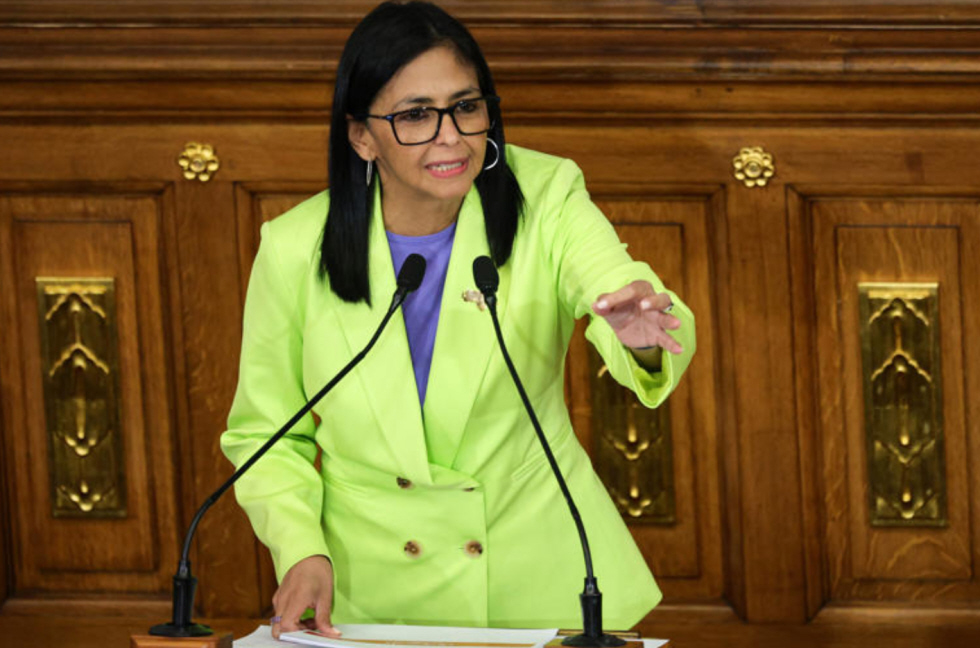
Venezuela’s interim president, Delcy Rodríguez, described the U.S. military operation carried out on January 3 as “a stain on the bilateral relationship,” after U.S. forces captured former president Nicolás Maduro. Despite the severity of the incident, Rodríguez said her government has chosen to pursue a diplomatic path to address the crisis. Rodríguez made the remarks during the annual presentation of the executive branch’s performance before the National Assembly, a constitutional ceremony held at the beginning of each year at the Federal Legislative Palace in Caracas.
The session was attended by foreign ambassadors, regional governors, and senior officials from the ruling party. In her address, Rodríguez emphasized that Venezuela is a sovereign nation with the right to maintain diplomatic relations with China, Russia, Iran, and Cuba, as well as with the United States. She stressed that these relationships cannot be dictated by external pressure or military actions.
The interim president characterized the U.S. operation as an “invasive aggression,” arguing that it deepens a long-standing history of tensions between Caracas and Washington. Nevertheless, she reiterated that her administration will seek to resolve the dispute through dialogue and diplomatic channels. A significant portion of her speech was devoted to honoring Nicolás Maduro and Cilia Flores, both captured during the January 3 operation, and to strengthening the morale of the Chavista movement in the aftermath of the events.
Rodríguez reaffirmed her commitment to the core principles of Chavismo, the political movement founded by former president Hugo Chávez. While presenting the official government performance document, Rodríguez stated that the work of the executive branch “belongs to President Maduro,” underscoring political continuity despite the abrupt shift in Venezuela’s leadership. Since early January, Venezuela’s political landscape has undergone rapid changes.
Rodríguez’s appointment as interim president aims to ensure institutional continuity amid a period marked by political uncertainty and heightened international tension. The episode adds a new layer to the already complex relationship between Venezuela and the United States, at a time when both governments face internal and external pressures. While the interim administration insists on diplomacy as the preferred course, the future direction of bilateral relations remains uncertain.