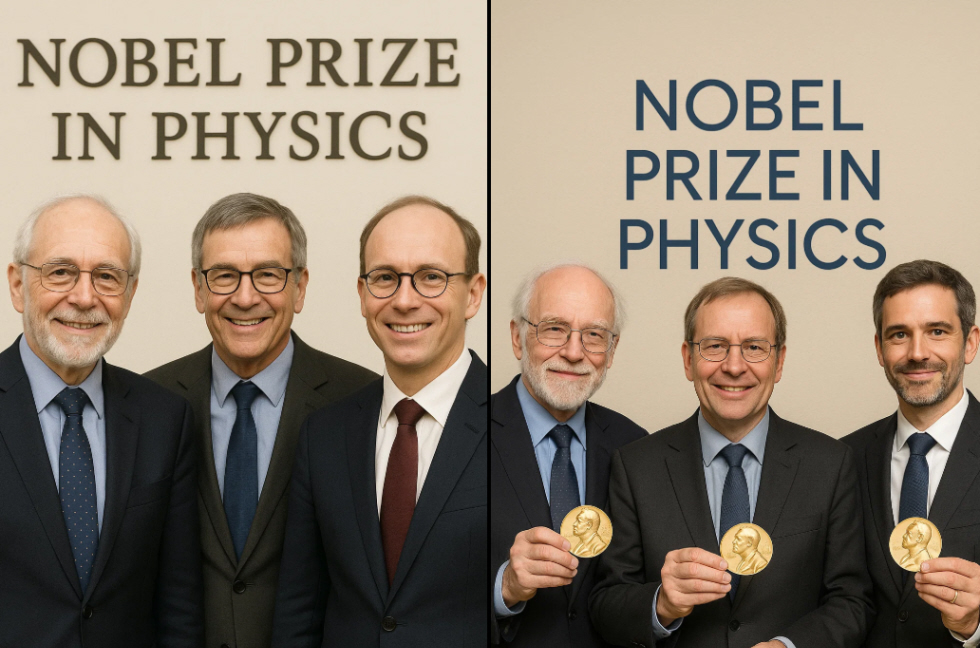
The Royal Swedish Academy of Sciences in Stockholm announced on Tuesday that the 2025 Nobel Prize in Physics has been awarded to three American researchers — John Clarke, Michel H. Devoret, and John M. Martinis — for their groundbreaking discoveries in quantum mechanics. According to the Nobel Committee, the trio is being recognized “for the discovery of macroscopic quantum tunneling and the quantization of energy in an electrical circuit.”
Their research represents a major step toward the development of more stable and efficient quantum computers, a field that could transform science, technology, and computing in the coming decades. The prize carries a value of 11 million Swedish kronor, approximately one million euros, and will be formally presented on December 10, the anniversary of Alfred Nobel’s death. Clarke, Devoret, and Martinis have been instrumental in expanding the understanding of macroscopic quantum systems, demonstrating how quantum effects can be measured and controlled in electrical circuits — an essential foundation for next-generation quantum technologies.
Last year’s Nobel Prize in Physics went to John Hopfield of the United States and Geoffrey Hinton of the United Kingdom and Canada, honored for their pioneering work in machine learning and neural networks, the core architecture behind today’s artificial intelligence revolution. Meanwhile, the 2025 Nobel Prize in Medicine was awarded to Mary E. Brunkow and Fred Ramsdell of the United States and Shimon Sakaguchi of Japan for their research on immune tolerance mechanisms — discoveries that explain how the human body prevents its immune system from attacking itself, paving the way for advances in autoimmune disease treatments.
Together, these honors reaffirm the scientific leadership of the United States and Japan, highlighting how international collaboration and innovation continue to drive breakthroughs in physics, medicine, and beyond — even amid global challenges and funding constraints.