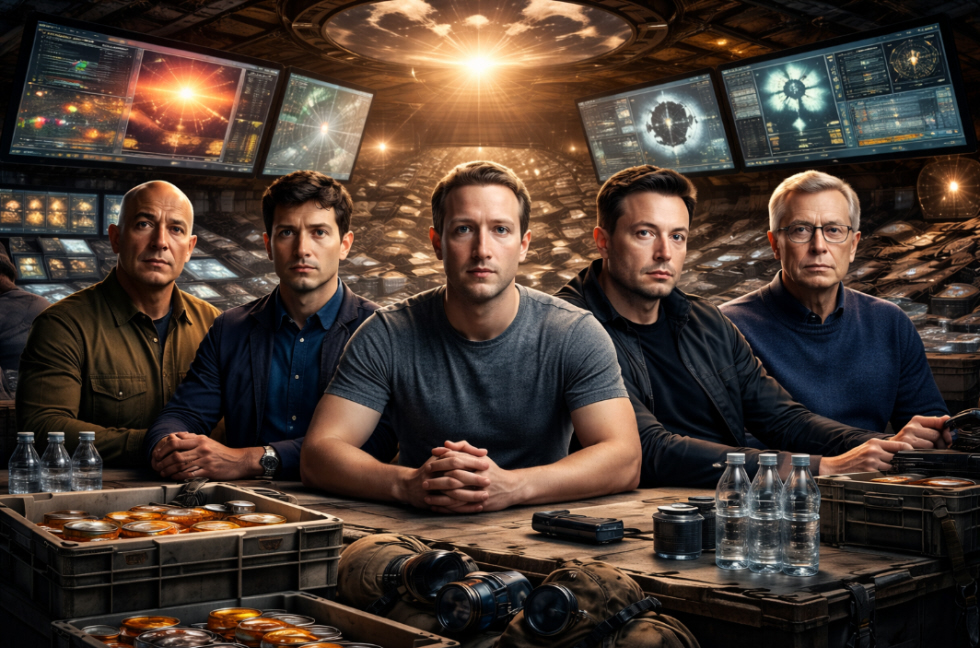
While the world debates artificial intelligence, wars, pandemics, and climate collapse, a powerful technological elite appears to be preparing for something far more extreme: the potential breakdown of civilization itself. In Silicon Valley, the construction of luxury doomsday bunkers has quietly evolved from fringe speculation into a booming industry. Among the names linked to this trend are some of the most influential figures on the planet. Meta founder Mark Zuckerberg has acknowledged the existence of an underground shelter on his property in Hawaii.
Investigative reports also point to individuals such as OpenAI CEO Sam Altman, Amazon founder Jeff Bezos, Microsoft co-founder Bill Gates, and PayPal founder Peter Thiel as being associated with similar preparations. None of these figures publicly speak of an “apocalypse,” yet the underlying message is unmistakable: something could go terribly wrong. Fears range from global conflicts and nuclear war to climate catastrophe and even risks stemming from the very technologies these leaders are helping to create. This growing anxiety has fueled a multibillion-dollar private industry specializing in high-end underground shelters.
These bunkers are equipped with advanced air filtration systems, independent energy supplies, years of food storage, medical facilities, and state-of-the-art security. Unlike Cold War-era shelters, today’s bunkers are not designed merely for survival, but for comfort during prolonged isolation. Many feature gyms, swimming pools, cinemas, hydroponic farms, and AI-driven systems to manage resources and security. The primary clients are not average citizens, but ultra-wealthy individuals with the means to insulate themselves from almost any global shock.
According to sociologists and technology analysts, this phenomenon reflects a deep lack of confidence in governments and public institutions to manage future crises. Ironically, many of the threats driving this underground movement are closely tied to the same technological ecosystem that generated these fortunes. Artificial intelligence, mass automation, and the concentration of digital power are increasingly viewed as potential sources of long-term social instability. Sam Altman, for example, has repeatedly warned about the existential risks of advanced AI while simultaneously leading one of the world’s most influential AI companies.
This dual role—shaping the future while quietly preparing to escape it—captures the moral tension surrounding Silicon Valley’s leadership. Critics argue that the rise of private bunkers highlights a stark form of inequality. While millions depend on fragile public systems in times of crisis, a small elite is securing exclusive sanctuaries designed to withstand global collapse.
Others interpret the trend less as a practical strategy and more as a psychological response: the anxiety of a class accustomed to controlling outcomes through technology, yet increasingly aware that some forces—natural, political, or human—remain beyond control. Whether driven by genuine fear or extreme precaution, one thing is clear: Silicon Valley’s doomsday bunkers are no longer science fiction.
They are a tangible sign of an era in which those building the future appear uncertain that it will be livable for everyone. In that sense, these underground fortresses say less about the end of the world than about the mindset of those who believe they might need to survive it alone.