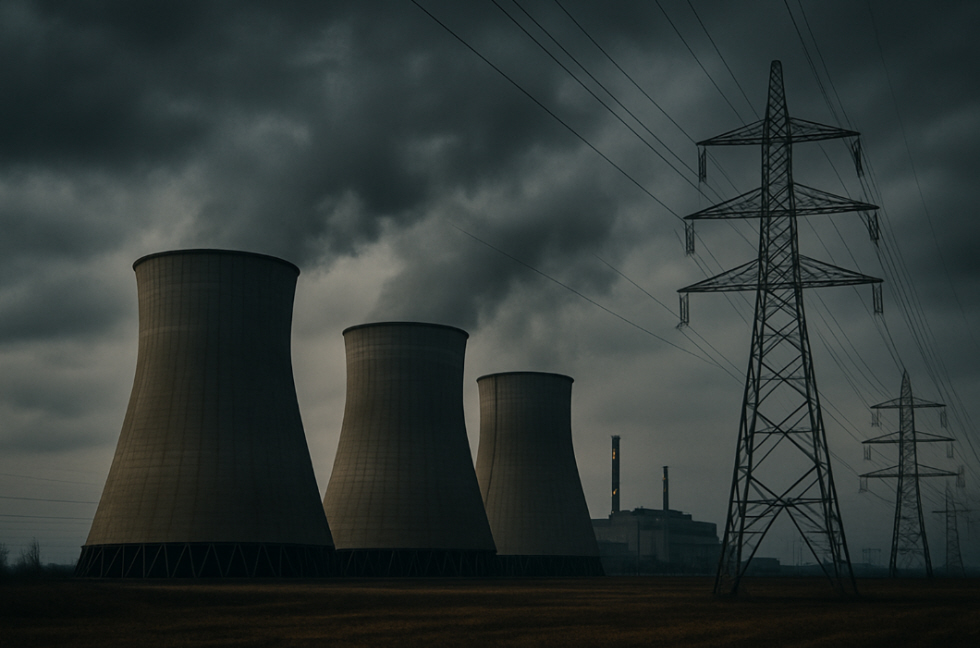
The reactors at the Zaporizhzhia nuclear power plant—Europe’s largest and one of the most sensitive sites in the Ukraine conflict—have once again become the focus of international concern following the publication of an analysis warning of critical vulnerabilities to direct military strikes. Although these reactors are engineered to withstand earthquakes, vibrations, and severe accidents, they were never designed to endure intentional or accidental bombardment during armed conflict.
Experts warn that if artillery were to hit a specific point in the structure, the resulting damage could trigger a cooling-system failure capable of leading to overheating and a potential core meltdown. Since the start of the Russian invasion in 2022, the plant—located roughly 1,000 kilometers from Austria—has remained under Russian military occupation and has repeatedly come under fire, prompting the International Atomic Energy Agency (IAEA) to issue ongoing warnings about the risk of a major nuclear accident should the fighting escalate.
The analysis, conducted by Nikolaus Müllner, director of the Institute for Safety and Risk Sciences at the University of Natural Resources and Life Sciences in Vienna, in cooperation with the Austrian Armed Forces’ NBC Defense Center, examined various weapons and munitions used in the Ukraine war to determine their potential impact on the Russian-designed VVER-1000/320 reactors. These reactors, also operating in several European countries, contain a particularly vulnerable area where all main live-steam and feedwater pipes converge into a narrow configuration near the building’s upper section.
This technical “bottleneck,” responsible for supplying cold water to the reactor and removing hot steam, represents a structural vulnerability in the event of a direct or accidental strike—similar to the unintended hits recorded in March 2022 on Unit 1 and the substation of Unit 6. While nuclear plants are generally built to withstand natural disasters, aircraft crashes, and even terrorism scenarios, they are not designed for sustained artillery bombardment. According to the study, if artillery fire were to strike this critical point and simultaneously destroy all connected feedwater and cooling lines, the reactor’s water could evaporate within roughly four hours, causing the core to overheat.
Two hours later, the reactor pressure vessel could rupture, and if this occurred under high internal pressure, the containment structure could also fail. In total, radioactive material could begin escaping approximately six hours after the initial impact. Although such a scenario remains extremely unlikely under normal conditions, researchers stress that it cannot be ruled out in an active war zone.
Should an event of this magnitude occur at Zaporizhzhia, radioactive release would be detectable even thousands of kilometers away, while the regional consequences would be severe, involving significant amounts of radioactive fallout and reigniting fears of a major nuclear disaster in Eastern Europe.