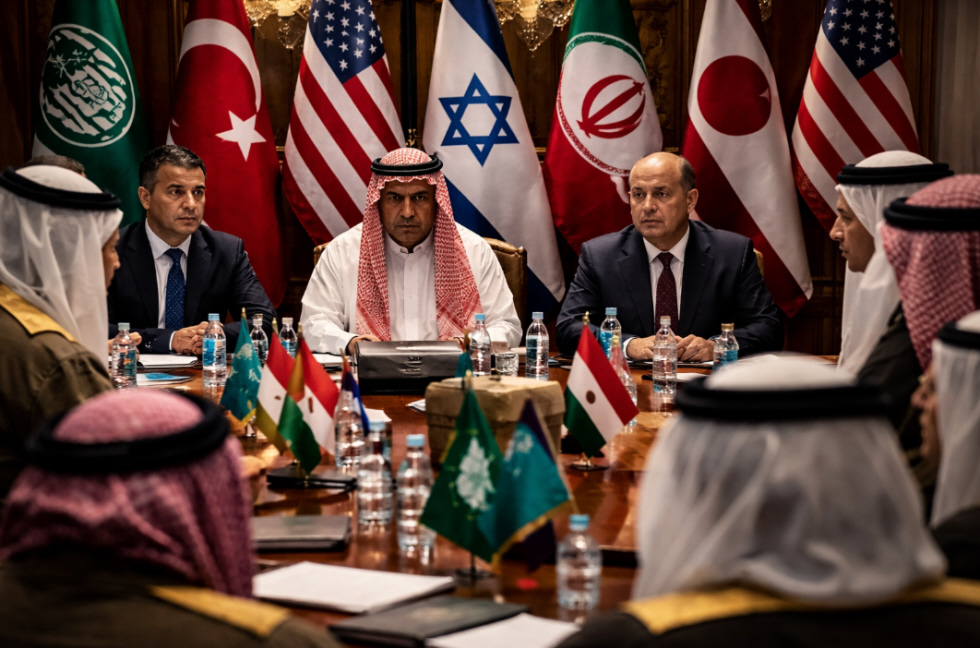
Several Arab and Muslim states reacted with strong indignation to recent remarks made by U.S. Ambassador to Israel Mike Huckabee concerning what he described as a “biblical right” of Israel over large parts of the Middle East. The comments quickly triggered diplomatic backlash in a region already marked by deep historical and political sensitivities.
During an interview, commentator Tucker Carlson asked whether, under a literal interpretation of the Bible, Israel could claim extensive areas of what is today the Middle East. Huckabee responded by saying, “It would be fine if they took it all,” a statement that rapidly circulated across international media and political circles. Shortly afterward, the ambassador appeared to walk back his remarks, stating that the question was irrelevant because Israel had no such intentions.
He clarified that Israel has the right to live within the territory it currently possesses. Despite the clarification, the initial statement was interpreted by several governments as implicitly endorsing expansive territorial claims rooted in religious interpretation. In a region where territorial disputes remain highly sensitive, references to biblical entitlement carry significant geopolitical weight.
In response, Saudi Arabia’s Ministry of Foreign Affairs released a joint statement supported by multiple Arab and Muslim states. The declaration was also backed by the Organization of Islamic Cooperation, the Arab League, and the Gulf Cooperation Council. The joint communiqué condemned the ambassador’s remarks “in the strongest possible terms” and expressed “deep concern” over the potential impact such statements could have on regional stability. Signatories argued that rhetoric of this nature undermines ongoing diplomatic efforts aimed at easing tensions.
Analysts note that the episode comes at a particularly delicate time for the Middle East, where multiple conflicts and fragile negotiations demand careful diplomatic language. Washington did not initially issue a broader official correction beyond the ambassador’s own clarification. However, the incident could prompt further diplomatic engagement to prevent strain in relations with key Arab partners.
Israel, for its part, has not announced any shift in its official policy, maintaining that its territorial stance is guided by security considerations and existing diplomatic agreements rather than expansive religious interpretations. The controversy has reignited debate over the role of historical and theological arguments in modern sovereignty disputes. In a region where religion, politics, and territory are deeply intertwined, diplomatic statements can carry far-reaching consequences.