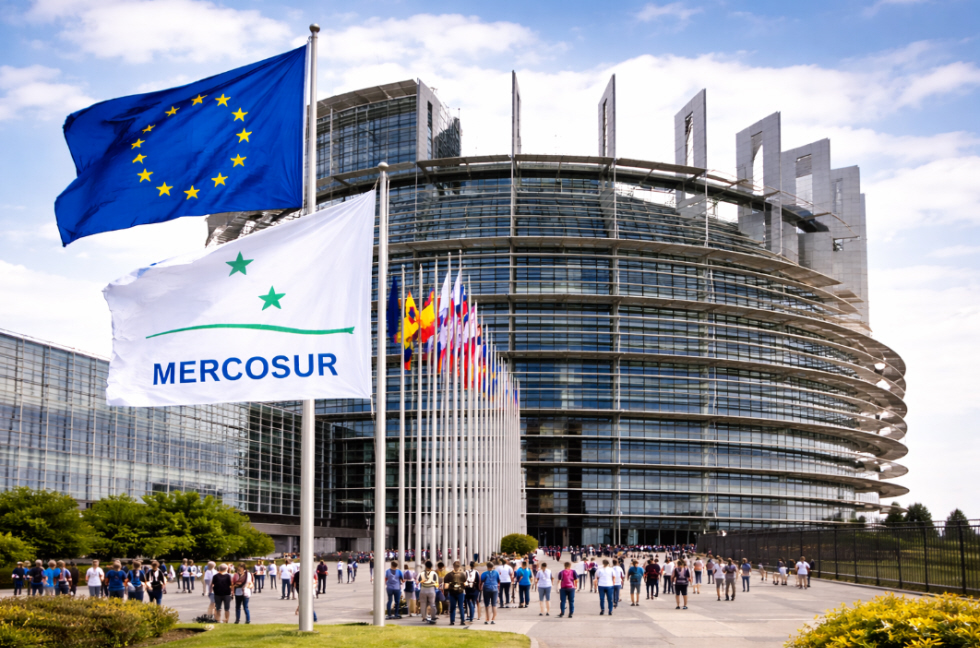
The European Parliament has decided to halt the ratification process of the trade agreement between the European Union and Mercosur, requesting the intervention of the European Union’s Court of Justice (CJEU) to assess whether the pact is compatible with EU law. The decision highlights deep political divisions surrounding one of the bloc’s most controversial trade deals.
The resolution was adopted by an extremely narrow margin, with 334 votes in favor, 324 against, and eleven abstentions, authorizing the President of the European Parliament to formally seek a legal opinion from the court. Under EU treaties, member states, the Parliament, or the European Commission may request such opinions before major international agreements proceed. While awaiting the court’s ruling, the Parliament will continue its preliminary review of the agreement, but made clear that no final vote will take place until the CJEU delivers its legal assessment.
Only after that opinion is issued will lawmakers decide whether to approve or reject the deal. In practical terms, the move places the ratification process on hold, coming just days after European Commission President Ursula von der Leyen signed the agreement in Paraguay. The original timetable envisioned a review by the Parliament’s Trade Committee followed by a plenary vote as early as May, a schedule that is now in doubt. Analysts warn that referring the agreement to the court could delay the process by up to two years, or even derail the deal entirely.
The EU–Mercosur agreement has long been one of the European Union’s most divisive trade initiatives, due to its economic scale and its political and social implications. The European Commission and several member governments continue to stress the strategic importance of concluding the agreement swiftly, particularly amid global geopolitical tensions and an increasingly complex transatlantic relationship. Supporters also argue that the pact would strengthen shared regulations, including food safety and sanitary standards.
Opposition remains strong among several groups, especially European farmers, who fear that EU markets could be flooded with cheaper agricultural products such as beef and poultry from South America. These concerns have fueled renewed protests outside the European Parliament in Strasbourg this week.
The parliamentary blockade confirms that the EU–Mercosur agreement has entered a critical and uncertain phase, shaped by legal scrutiny, political pressure, and social resistance. The ruling of the Court of Justice will be decisive in determining whether the deal advances, is reshaped, or ultimately collapses.