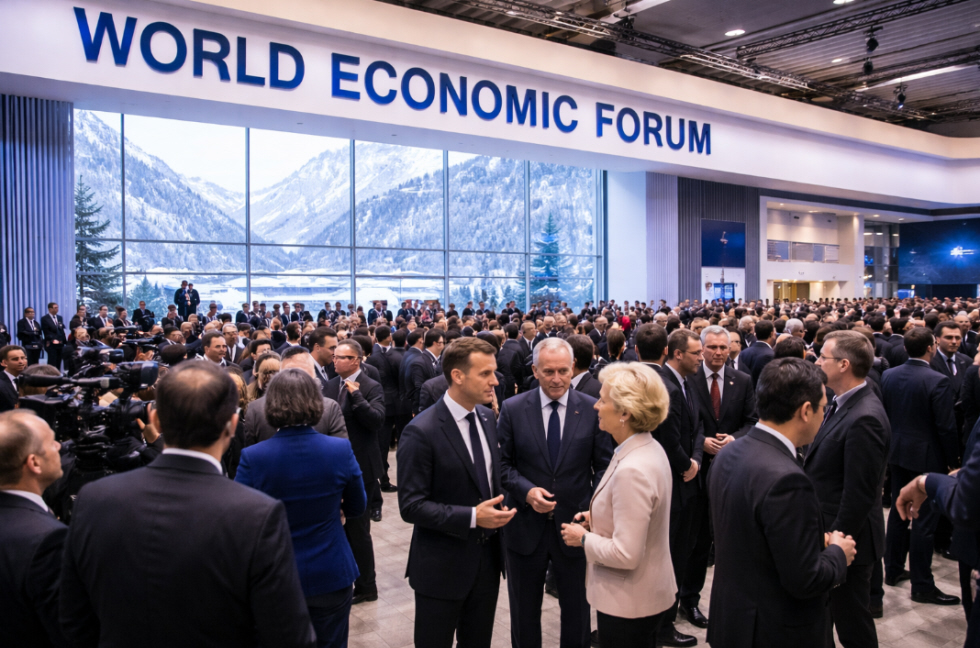
The World Economic Forum officially opened its new edition in Davos with the presence of political leaders, business executives, and international representatives, but the atmosphere was marked by a clear expectation: the arrival of U.S. President Donald Trump. Although the program includes high-level interventions, much of the attention is focused on his speech and the impact of his recent statements regarding Greenland.
From the start of the meeting, the political debate was overshadowed by tensions generated by Trump, whose warnings and threats have altered the forum’s traditional agenda. In the corridors of Davos, diplomats and executives agree that the focus is no longer solely on the global economy, but on the geopolitical uncertainty affecting transatlantic relations. During the opening day, figures such as European Commission President Ursula von der Leyen, French President Emmanuel Macron, and Chinese Vice Premier He Lifeng addressed key issues including economic stability, trade, and artificial intelligence.
However, their interventions unfolded under the shadow of Trump’s possible presence and the questions surrounding his foreign policy approach. Attention has also turned to Ukraine. President Volodymyr Zelensky is weighing whether to attend the forum and, according to diplomatic sources, would only travel to Switzerland if there is a meaningful opportunity to meet with Trump. Kyiv is seeking concrete security guarantees and clear commitments from the United States amid intensified Russian air attacks.
In the absence of confirmation of a high-level meeting, Zelensky has kept open the option of remaining in Kyiv to manage the military situation. This uncertainty reflects the delicate balance between international diplomacy and urgent security concerns shaping the forum’s agenda. Beyond the major powers, Davos continues to serve as a venue for bilateral and multilateral meetings among heads of government, regional leaders, and top executives from major technology companies. Discussions center on the reconfiguration of supply chains, industrial transition, and the role of technology in an increasingly fragmented global landscape.
This year’s forum brings together nearly 3,000 participants, including politicians, corporate leaders, and experts, who will debate global economic trends, trade, and artificial intelligence through Thursday under the banner of dialogue. Yet the traditional spirit of consensus in Davos is under strain amid rising strategic rivalries. As a result, the summit in the quiet Swiss alpine resort is unfolding in a climate of anticipation and uncertainty. More than official statements, what happens on the sidelines of the forum — and especially what Trump says or does — is likely to define the true political tone of Davos this year.